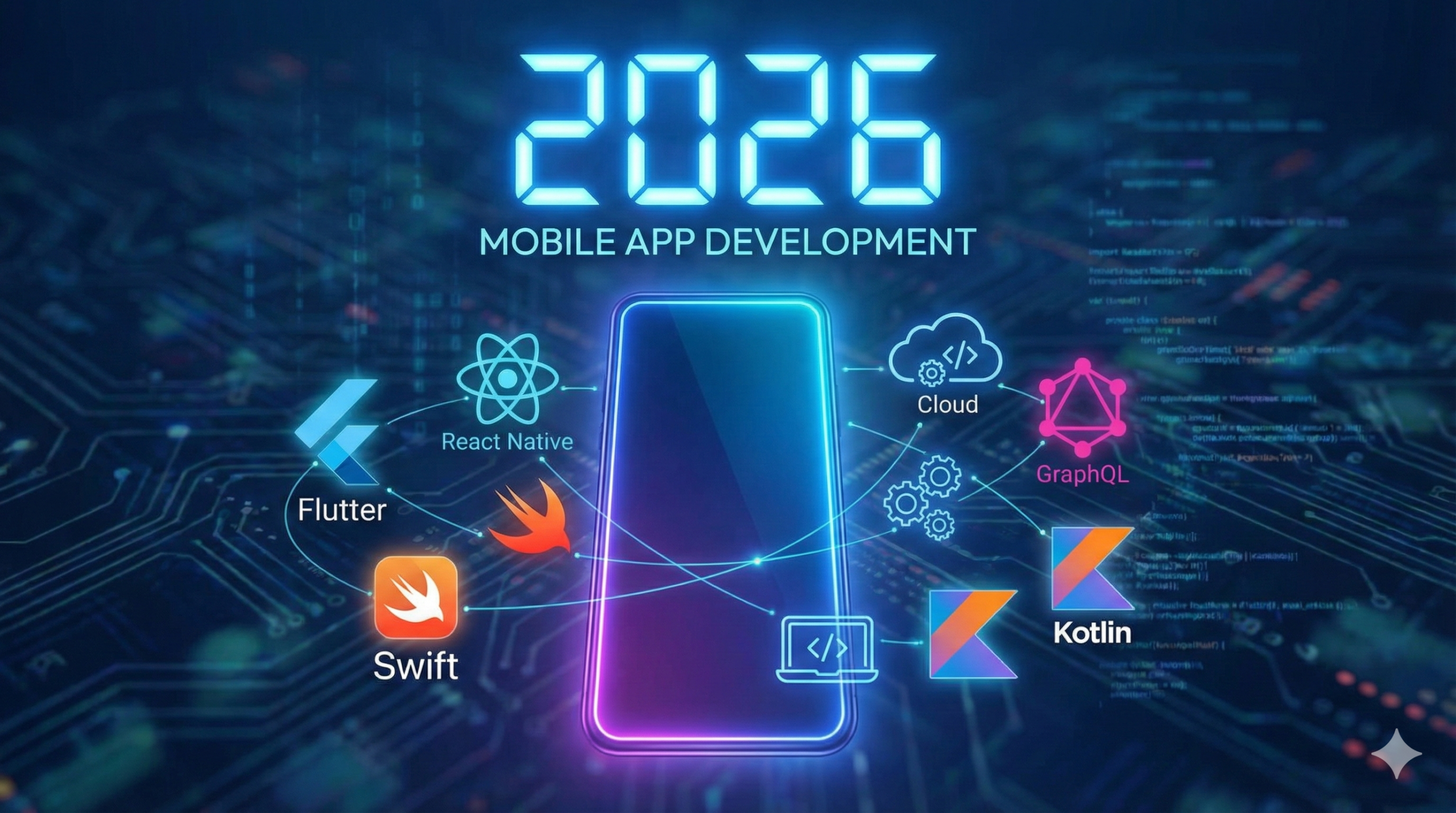
Best Tech Stack for Mobile App Development in 2026

best_tech_stack_for_mobile_app_2026

Choosing the best tech stack for mobile app development is one of the most important decisions startups and businesses make before building an app.

The right mobile app technology stack affects:

  • Development cost
  • Time to launch
  • App performance
  • Scalability
  • Long-term maintenance

In 2026, mobile apps are no longer just about screens β€” they require scalable backends, real-time systems, AI integrations, and cloud-ready architecture.

πŸ‘‰ If you’re planning to build an app: Explore Our Mobile App Development Services

What Is a Mobile App Tech Stack?

A mobile app tech stack is the combination of:

  • Programming languages
  • Frameworks
  • Backend technologies
  • Databases
  • Cloud infrastructure

that power your mobile application.

Choosing the wrong stack can lead to:
❌ Slow performance
❌ Expensive rewrites
❌ Scaling issues

Choosing the right stack helps you:

βœ” Launch faster
βœ” Reduce costs
βœ” Build scalable products

Native vs Cross-Platform Tech Stack in 2026

Before selecting tools, you must choose your approach.

Native App Development Stack

Native apps are built specifically for:

  • iOS
  • Android

They offer:

βœ” Best performance
βœ” Better security
βœ” Long-term scalability

Learn more here:
iOS Vs Android: Which platform you should build first ?

Cross-Platform Development Stack

Cross-platform apps allow you to build for:

  • iOS
  • Android

using a shared codebase.

They help:

βœ” Reduce development cost
βœ” Launch faster
βœ” Build MVPs efficiently

πŸ‘‰ Many startups start with cross-platform MVPs before scaling.

Best iOS Tech Stack in 2026

If you’re building for Apple users, this is the modern stack:

Language
  • Swift

Swift continues to dominate iOS app development due to:

  • Performance
  • Safety
  • Apple ecosystem support
UI Framework
  • SwiftUI

SwiftUI enables:

βœ” Faster UI development
βœ” Cleaner architecture
βœ” Real-time previews

πŸ‘‰ This is the stack we use for scalable iOS apps at Nerdware Labs

Best Android Tech Stack in 2026

Android continues to power the majority of global mobile users.

Language
  • Kotlin

Kotlin is now the industry standard for Android app development.

UI Framework
  • Jetpack Compose

Jetpack Compose enables:

βœ” Modern UI
βœ” Faster iteration
βœ” Reduced boilerplate code

If your app targets mass adoption, Android is often essential.

πŸ‘‰ Learn the cost implications here: Mobile App Development Cost Guide

Best Cross-Platform Stack in 2026

For startups and MVPs, cross-platform remains powerful.

Flutter

Flutter continues to lead in:

  • Performance
  • UI consistency
  • Startup MVP development

Best for:

βœ” MVP apps
βœ” Budget-conscious startups
βœ” Fast launches

Backend Tech Stack for Mobile Apps

Mobile apps need scalable backend systems.

Recommended Backend Stack
ComponentTech
API LayerNode.js / PHP / Python
AuthenticationJWT / OAuth
RealtimeWebSockets
CloudAWS / GCP

Backend architecture directly impacts:

  • Performance
  • Security
  • Scalability

πŸ‘‰ See how we architect scalable systems: Software Development & Cloud Solutions

Best Database Stack in 2026

Choosing the right database depends on app type.

SQL Databases
  • PostgreSQL
  • MySQL

Best for:

βœ” Structured data
βœ” Reliability

NoSQL Databases
  • MongoDB
  • Firebase

Best for:

βœ” Real-time apps
βœ” Rapid scaling

Cloud & DevOps Stack

Modern mobile apps are cloud-first.

Recommended stack:

  • AWS
  • Google Cloud
  • Docker
  • CI/CD pipelines

Cloud-ready apps scale faster and reduce downtime.

AI-Ready Mobile Stack (Future-Proofing)

In 2026, apps increasingly integrate:

  • AI recommendations
  • Personalization
  • Automation

Tech like:

  • TensorFlow
  • OpenAI APIs

are becoming part of modern stacks.

Best Tech Stack for Startup MVPs

If you’re building an MVP, the ideal stack is:

βœ” Fast
βœ” Cost-efficient
βœ” Scalable

Typical MVP stack:

  • Flutter (frontend)
  • Node.js backend
  • PostgreSQL
  • AWS

Most MVP apps today fall between
πŸ‘‰ $10,000 – $40,000
when built efficiently.

How to Choose the Right Mobile App Stack

Ask yourself:

  • Who is your target audience?
  • What’s your budget?
  • Do you need scalability?
  • Do you need speed-to-market?

There is no universal stack β€” only the right stack for your product.

Why Businesses Choose Nerdware Labs

At Nerdware Labs, we help startups and businesses:

βœ” Choose the right tech stack
βœ” Build scalable mobile apps
βœ” Launch MVPs faster
βœ” Avoid costly rebuilds

With 14+ years of experience, we design technology stacks that grow with your business.
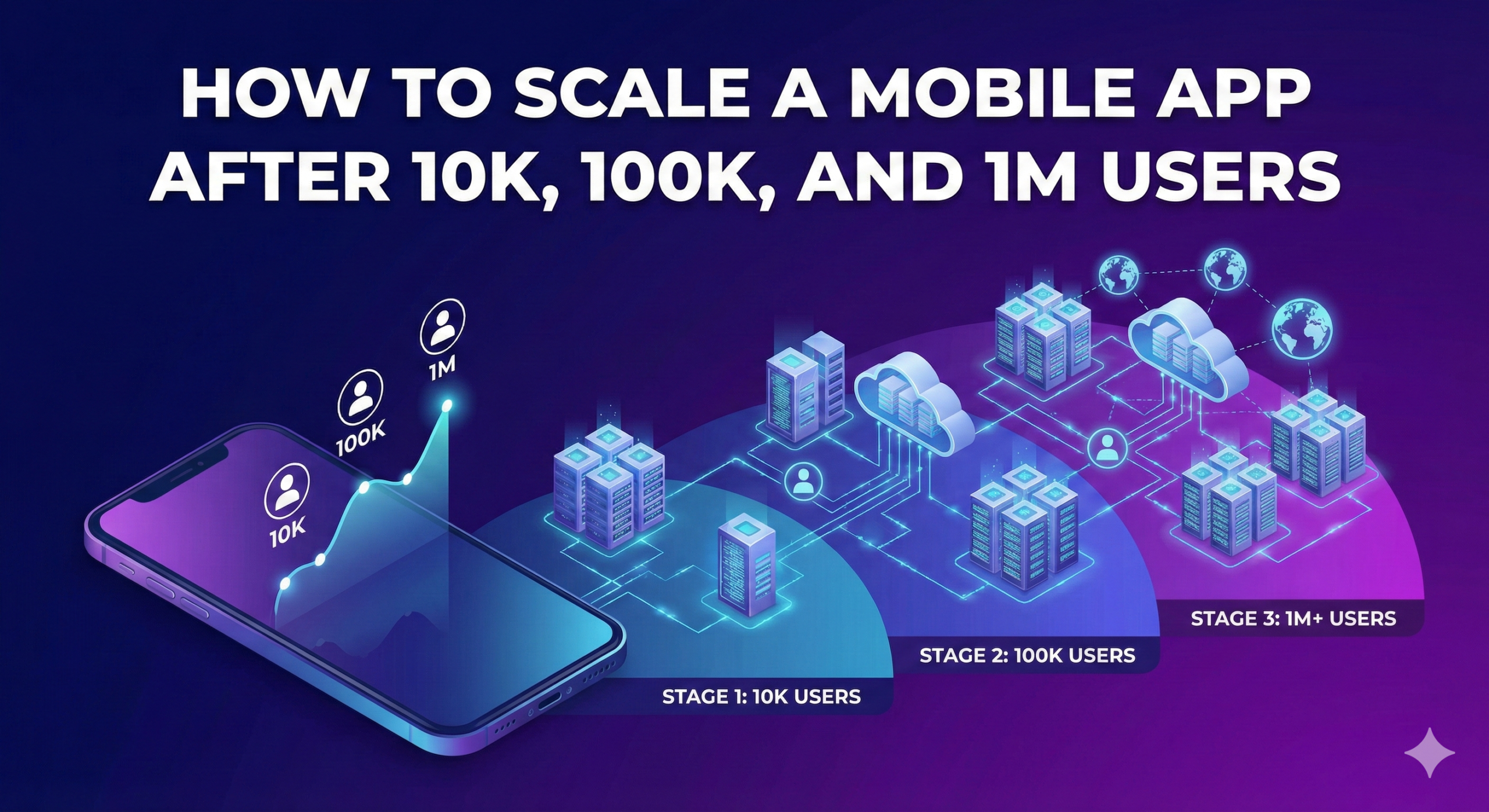
How to Scale a Mobile App After 10K, 100K, and 1M Users

how-to-scale-a-mobile-app

Launching a mobile app is a big milestone β€” but scaling it successfully is what determines long-term success.

Many startups build great apps, reach early traction, and then struggle when growth begins. Performance slows down, infrastructure becomes unstable, and user experience suffers.

Scaling isn’t just about adding servers.
It’s about building the right architecture, backend systems, and user experience to support real growth.
If you’re planning to build or scale an app, it’s critical to understand how scaling works at:

  • 10K users
  • 100K users
  • 1M users

If you’re still planning your product, check out our
How Much Does It Cost to Build a Mobile App to understand the cost implications of scalable architecture.

Why Scaling a Mobile App Matters

User growth often brings unexpected technical challenges.
Without proper planning, growth can lead to:

  • Slow performance
  • App crashes
  • API failures
  • High infrastructure costs
  • Poor user retention

Scaling correctly ensures your mobile app:

βœ” Handles user spikes
βœ” Maintains performance
βœ” Supports long-term growth
βœ” Delivers consistent user experience

If you’re deciding platform strategy before scaling, read:
iOS vs Android Development: Which Is Better?

Scaling After 10K Users

Reaching 10,000 users is your first real stress test.

At this stage, focus on stability.

1. Optimize Your Backend

Most MVP apps are built quickly β€” not built to scale.
Now is the time to:

  • Improve API performance
  • Optimize database queries
  • Reduce response times

Our Software Development & Cloud Solutions help startups strengthen backend systems before traffic grows further.

2. Add Load Handling

Introduce:

  • Load balancing
  • Caching
  • API monitoring

This ensures your app doesn’t crash during traffic spikes.

3. Start Tracking User Behavior

Use analytics to understand:

  • Feature usage
  • Drop-offs
  • Retention

This helps prioritize improvements before scaling further.

Scaling After 100K Users

At 100K users, your app becomes a real product.
This is where poor architecture begins to break.

1. Shift to Scalable Architecture

You may need:

  • Microservices
  • Queue-based processing
  • Horizontal scaling

Apps built without scalable architecture often fail here.
This is why building scalable systems early matters β€” something we prioritize in our Mobile App Development Services

2. Improve Database Performance

At this stage:

  • Single databases struggle
  • Read replicas become necessary
  • CDN usage improves performance
3. Optimize User Experience

More users = higher expectations.

Ensure:

  • Fast load time
  • Smooth UI
  • Reliable APIs

User retention depends heavily on performance.

4. Strengthen Security

Growth increases data exposure.

Now is the time to implement:

  • Secure authentication
  • Encryption
  • Rate limiting

Scaling After 1M Users

This is enterprise-level scale.

Now scaling becomes continuous.

1. Move to Full Cloud Infrastructure

You may require:

  • Auto-scaling servers
  • Multi-region deployment
  • Failover systems

Our Custom Cloud Solutions support growing apps at this stage.

2. Introduce DevOps Monitoring

You must monitor:

  • Server health
  • App performance
  • User flows

Scaling is no longer manual β€” it becomes operational.

3. Optimize Costs

Infrastructure costs grow fast.

Reduce:

  • Unnecessary API calls
  • Storage load
  • Processing waste

Smart architecture prevents cost explosions.

4. Maintain UX Consistency

At scale:

  • Lag increases
  • Small UX issues grow bigger

Many companies revisit UI/UX during this stage.

Common Scaling Mistakes

Avoid:

❌ Ignoring backend architecture
❌ Scaling too late
❌ Overengineering too early
❌ Weak monitoring
❌ Poor database planning

Most scaling failures happen because apps weren’t built with growth in mind.

Build for Growth from Day One

Successful apps scale smoothly because they:

  • Start lean
  • Plan ahead
  • Evolve gradually

At Nerdware Labs, we help startups build:

βœ” Scalable MVPs
βœ” Production-ready mobile apps
βœ” Cloud-ready backend systems

Final Thoughts

Scaling happens in stages:

  • 10K users β†’ Stability
  • 100K users β†’ Architecture
  • 1M users β†’ Infrastructure

The earlier you prepare, the smoother your growth journey will be.

πŸš€ Need Help Scaling Your Mobile App?

Whether you’re preparing for growth or already experiencing traffic challenges:
πŸ‘‰ Book a Free Consultation

We help startups and businesses build mobile apps designed to scale from day one.

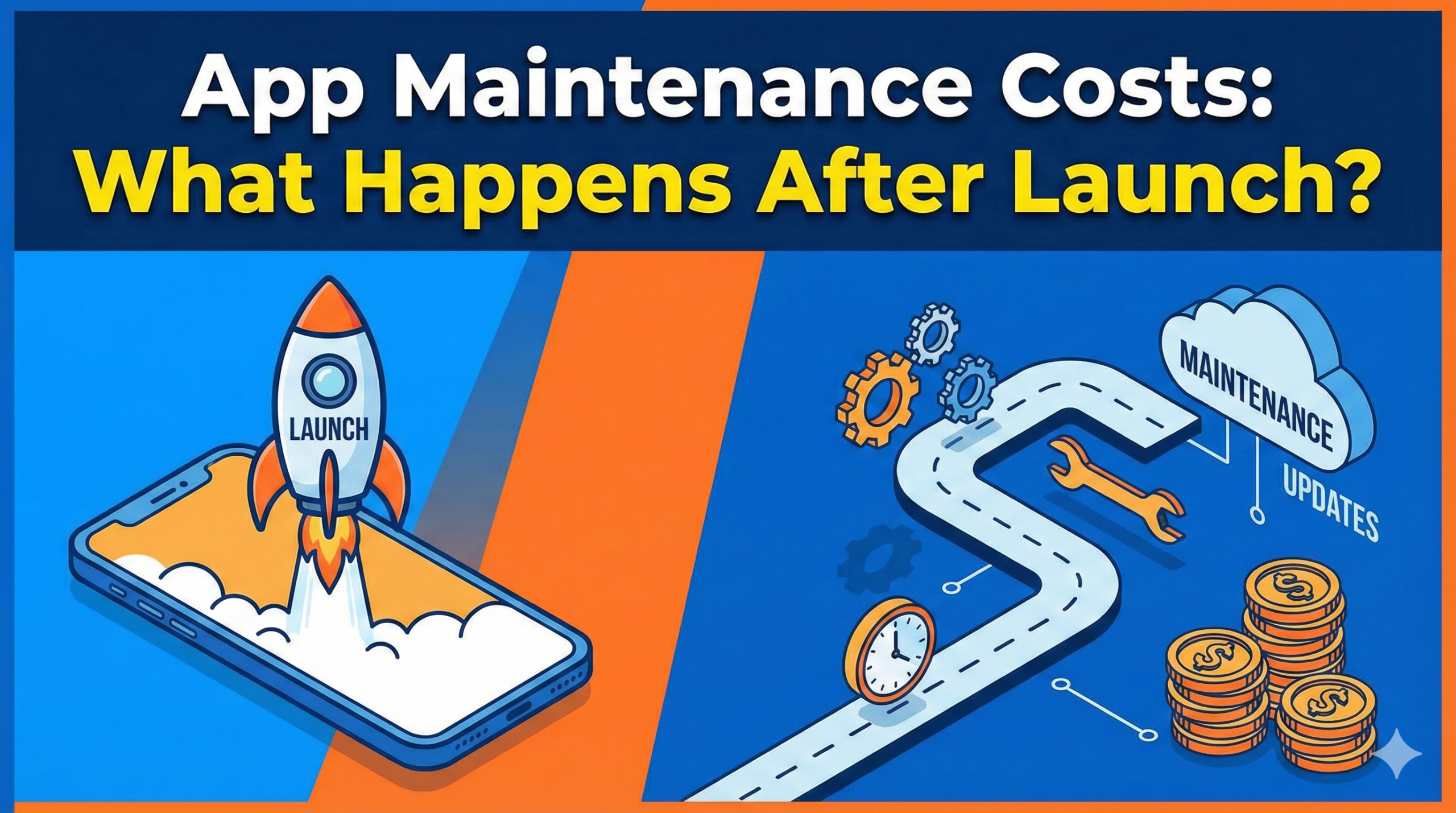
App Maintenance Costs: What Happens After Launch?

app_maintenance_costs_what_happens_after_launch

Launching your mobile app is a huge milestone β€” but it’s not the finish line.
Many startups believe the major investment ends once their app goes live.

In reality, mobile app maintenance is what determines whether your app grows… or fades away.

If you’re planning to build an app, understanding post-launch mobile app costs, ongoing development, and long-term scalability is essential for success.

Why App Maintenance Is Critical

A successful mobile app is not a one-time build β€” it’s an evolving product.
After launch, your app must:

  • Stay compatible with iOS & Android updates
  • Fix bugs & crashes
  • Improve performance
  • Add new features
  • Maintain security
  • Scale with growing users

Without ongoing support, even the best-built apps struggle to survive.

πŸ‘‰ Need expert support to maintain or scale your app?
Talk to our team at Nerdware Labs to ensure your app stays future-ready.

What Are the Key App Maintenance Costs?

Here’s what typically happens after launch.

1. Bug Fixes & Stability Updates

No app launches without issues.
Post-launch maintenance includes:

  • Crash fixes
  • UI improvements
  • Performance optimization

Ignoring these leads to poor ratings and user churn.

Many startups underestimate this β€” something we discussed here

πŸ“Œ Want a reliable team to handle post-launch updates?
Nerdware Labs provides ongoing mobile app support so you don’t lose users due to technical issues.

2. OS Updates & Compatibility

Every year:

  • Apple releases new iOS versions
  • Google updates Android APIs

Your app must evolve too.

Without updates:

  • Features break
  • App store compliance fails
  • User experience declines

πŸ‘‰ Already launched an app and struggling with compatibility issues?
Let our mobile app maintenance experts help you stay ahead.

3. Feature Enhancements

Most successful apps evolve post-launch.

Maintenance often includes:

  • UX improvements
  • AI integrations
  • Payment modules
  • Analytics

If you started with an MVP, this is your growth phase. Learn more

πŸš€ Ready to scale your MVP into a full product?
Our team specializes in turning MVPs into scalable mobile apps.

4. Security Updates

Security is ongoing.
Maintenance includes:

  • Data protection
  • API updates
  • Compliance support

This is critical for fintech, healthcare, and marketplace apps.

πŸ‘‰ Need secure app infrastructure?
We help businesses maintain enterprise-grade security.

5. Backend & Infrastructure Scaling

Your app relies on:

  • Servers
  • APIs
  • Databases

As users grow, infrastructure must scale.
Maintenance ensures:

  • Smooth performance
  • Reliable uptime
  • Future scalability

πŸ‘‰ Looking to scale your app without downtime?
Nerdware Labs can optimize your backend architecture.

6. Performance Optimization

Slow apps lose users.
Maintenance improves:

  • Load speed
  • Battery usage
  • Memory efficiency

This directly impacts retention and App Store ranking.

πŸ“ˆ Want better performance and user retention?
We provide continuous optimization services for mobile apps.

Typical App Maintenance Cost

Annual maintenance usually costs:
πŸ‘‰ 15%–25% of initial development cost

If you’re unsure about development costs, read our guide.

Tech Stack Impacts Maintenance Cost

Choosing between native and cross-platform affects long-term cost.
Compare here

Reducing Costs with Remote Development

Many companies use remote teams for ongoing support.
πŸ‘‰ Learn more

πŸ‘‰ Need a reliable remote mobile development partner?
Our India-based team helps startups reduce long-term costs.

Platform Strategy Matters

iOS-first or Android-first?
This affects future maintenance.

Read our guide “iOS vs Android Development which is better for your app in 2026

Plan Maintenance Early

Smart founders plan maintenance alongside development.
If you’re still in planning: We have a complete guide for you, read here

Why Choose Nerdware Labs?

We help businesses with:

βœ” Ongoing app maintenance
βœ” Feature expansion
βœ” Performance optimization
βœ” Security updates
βœ” Backend scaling

Whether you’re launching a new app or improving an existing one β€” we’ve got you covered.

πŸš€ Let’s Keep Your App Growing

Already launched your app?
Planning one?

Don’t let post-launch challenges slow you down.

πŸ‘‰ Contact Nerdware Labs today to:

  • Maintain your app
  • Improve performance
  • Add new features
  • Scale with confidence

Book a free consultation and future-proof your mobile app today.

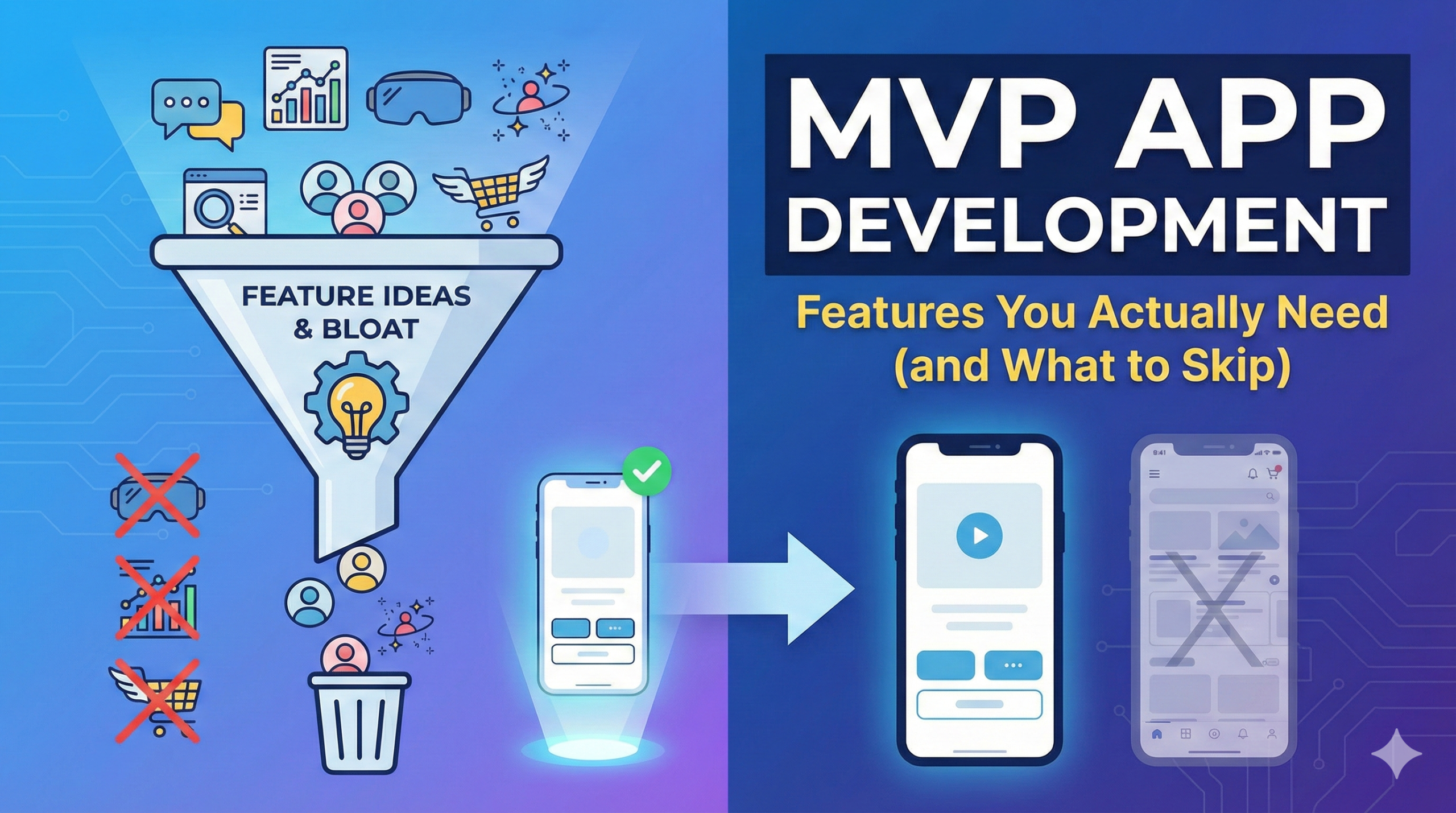
MVP App Development: Features You Actually Need (and What to Skip)

Building an MVP is one of the smartest ways for startups to validate an idea without wasting time or money. Yet, many founders make the same mistake: they overbuild their MVP.

In this guide, we’ll break down what features your MVP app actually needs, what you should skip, and how to build a lean, production-ready MVP that attracts users, investors, and early traction.

πŸ‘‰ If you’re planning MVP app development and want expert guidance from day one,
you can talk to our team at Nerdware Labs for a free consultation.

What Is an MVP App (And What It Is Not)

An MVP (Minimum Viable Product) is the simplest version of your app that delivers real value to users and allows you to validate your idea in the market.

An MVP is:

  • A working product
  • Focused on one core problem
  • Built for real users
  • Designed for learning and iteration

An MVP is not:

  • A demo or mockup
  • A half-baked prototype
  • A feature-heavy product
  • A long-term final solution

πŸ’‘ Many founders confuse MVPs with full apps. If cost is your concern, read
How Much Does It Cost to Build a Mobile App?

Why Feature Selection Matters in MVP Development

Every extra feature:

  • Increases development cost
  • Delays launch
  • Adds complexity
  • Creates technical debt
  • Reduces clarity for users

Startups that win focus on the smallest feature set that solves a painful problem well.

πŸ‘‰ Not sure which features are essential for your MVP?
Our mobile app development team help founders define a clear MVP scope before writing a single line of code.

Core MVP App Features You Actually Need

1. Core User Flow (Non-Negotiable)

Your MVP must support one clear user journey from start to finish.

Ask:

  • What is the one thing users come here to do?
  • Can they do it in under 3–5 steps?

If your app doesn’t nail the core flow, no amount of features will save it.

πŸ‘‰ We help startups design MVP user flows that are simple, fast, and conversion-focused.


2. Simple User Authentication

Most MVP apps need basic authentication:

  • Email + password
  • Phone login
  • Magic link login

Avoid complex enterprise-grade access control early.
Simple, secure, and reliable wins for MVPs.


3. Clean, Usable UI (Not Fancy Design)

Good MVP UI is about clarity, not decoration.

Focus on:

  • Easy navigation
  • Clear actions
  • Simple layouts

Skip heavy animations, visual effects, and custom artwork.

πŸ‘‰ If you’re deciding between platforms, read
iOS vs Android Development: Which Is Better?.


4. Backend & Database (Built to Scale)

Even MVPs need a proper backend foundation:

  • Secure APIs
  • Scalable database
  • Clean architecture

Cutting corners here leads to expensive rewrites later.

πŸ‘‰ Our backend-first approach is explained in
Software Development & Custom Cloud Solutions


5. Basic Admin Panel

A lightweight admin panel helps you:

  • Manage users
  • Edit content
  • Handle early support issues

You don’t need analytics dashboards or complex permissions yet.


6. Basic Analytics & Feedback

To learn fast, track only what matters:

  • Signups
  • Core actions
  • Drop-offs
  • User feedback

πŸ‘‰ MVP analytics are part of every project we deliver under
our mobile app development services.

MVP App Features You Should Skip (At Least Initially)

This is where most startups burn money.

❌ Advanced personalization
❌ AI recommendations
❌ Multi-language support
❌ Complex notification engines
❌ Edge-case-heavy logic

If these features don’t help validate your idea, they don’t belong in your MVP.

How MVP Features Affect Development Cost

MVP app development cost depends mostly on feature complexity.

For most startups:

  • $10,000 – $40,000 is a realistic MVP range

Costs rise sharply with:

  • Real-time systems
  • Advanced UX
  • Heavy third-party integrations
  • Overengineering

πŸ‘‰ If you want a deeper breakdown, read Mobile App Development Cost Guide
We provide free MVP cost breakdowns based on your idea.

Native vs Cross-Platform for MVPs

  • Native apps β†’ better performance, faster iteration
  • Cross-platform apps β†’ faster reach, lower initial cost

There’s no universal answer β€” it depends on your users and goals.

πŸ‘‰ We help founders choose the right platform before development starts.

How Nerdware Labs Builds MVPs That Actually Work

At Nerdware Labs, we specialize in startup MVP development.

What makes us different:

  • 14+ years of engineering experience
  • Product-first mindset (we’ve built our own product)
  • Clean, scalable architecture
  • Clear communication & ownership
  • Startup-friendly pricing

We don’t just build apps β€” we help founders validate ideas and move fast.

Final Thoughts: Build Less, Learn Faster

The best MVPs are not the biggest β€” they are the most focused.

If you’re planning MVP app development:

  • Build only what’s essential
  • Skip everything else
  • Launch fast
  • Learn from real users

That’s how successful startups are built.