
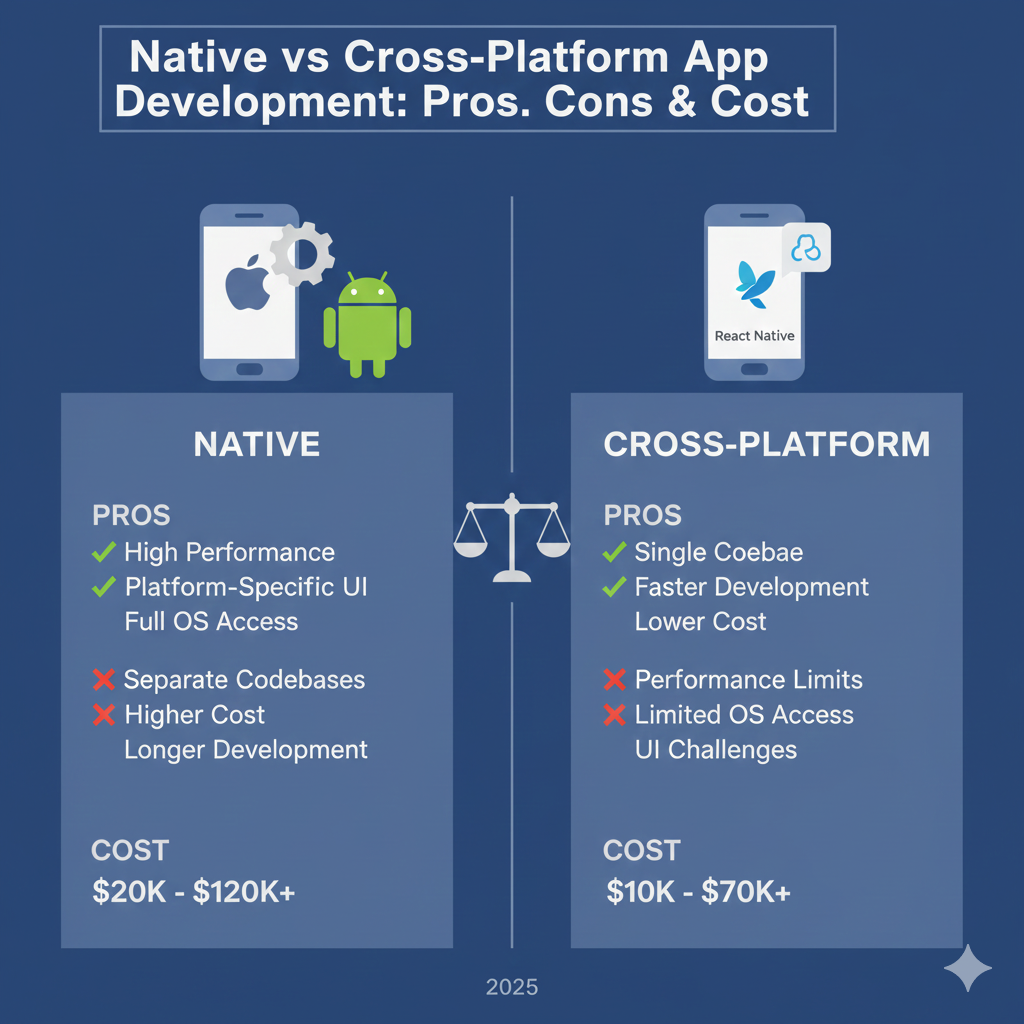
In today’s digital economy, choosing the right mobile app development approach can determine whether your product becomes a market leader or an expensive failure. One of the most critical decisions businesses face is whether to build a Native app or a Cross-Platform app.
If you are planning to build a mobile product, our mobile app development services help startups and enterprises choose the right technology from day one.
This guide will help you understand the difference between Native and Cross-Platform app development, their pros and cons, development costs, and which approach is best for your business in 2025.
💡 Not sure which approach is right for your idea?
👉 Get a free consultation with our app experts
What Is Native App Development?
Native app development means building an application specifically for one operating system.
| Platform | Programming Language |
|---|---|
| iOS | Swift, Objective-C |
| Android | Kotlin, Java |
Native apps directly interact with the device’s operating system, hardware, and UI components.
If you are targeting premium performance or App Store rankings, our iOS app development and Android app development teams specialize in high-performance native builds.
🚀 Building a high-performance mobile app?
👉 Talk to our iOS & Android development team
What Is Cross-Platform App Development?
Cross-platform development allows developers to write one codebase that runs on multiple platforms like iOS and Android.
Popular cross-platform frameworks include:
- Flutter
- React Native
- Xamarin
- Ionic
This approach focuses on code reusability and faster development.
Our cross-platform app development services are ideal for startups that need to launch quickly with a limited budget.
⏱ Want to launch your app faster?
👉 Get a cross-platform MVP estimate
Native vs Cross-Platform: Key Differences
| Feature | Native Apps | Cross-Platform Apps |
|---|---|---|
| Performance | Excellent | Moderate To High |
| User Experience | Best | Good |
| Development Time | Longer | Faster |
| Cost | Higher | Lowest |
| Hardware Access | Full | Limited |
| App Size | Smaller | Larger |
| UI Responsiveness | Native Smooth | Slightly Slower |
| Maintenance | Separate Codebases | Single Codebase |
📊 Want to know which option fits your budget and timeline?
👉 Request a free project estimate
Pros of Native App Development
1. Best Performance
Native apps are compiled directly into machine code, making them extremely fast and responsive.
2. Superior User Experience
They follow platform-specific design guidelines (Material Design for Android, Human Interface Guidelines for iOS).
3. Full Access to Device Features
You can access GPS, Bluetooth, camera, biometrics, and system APIs without limitations.
4. Higher App Store Ranking
Google Play and Apple App Store prefer fast, stable native apps, which improves your ASO and SEO ranking — one reason many enterprises choose native mobile app development.
Cons of Native App Development
- Higher development cost
- Two separate teams required (iOS + Android)
- Longer time to market
- More expensive maintenance
Pros of Cross-Platform App Development
1. Lower Development Cost
One codebase for two platforms reduces engineering expenses by up to 40–50%.
2. Faster Time to Market
Develop once, deploy everywhere.
3. Easier Maintenance
Fix a bug once and it works on both iOS and Android.
4. Ideal for MVPs & Startups
Cross-platform frameworks are perfect for validating ideas before investing in full native app development.
Cons of Cross-Platform Development
- Slightly lower performance
- UI may not feel fully native
- Limited access to advanced APIs
- Depends heavily on third-party frameworks
Cost Comparison: Native vs Cross-Platform Apps
| App Type | Native Cost | Cross Platform Cost |
|---|---|---|
| Simple App | $15,000 – $30,000 | $8,000 – $18,000 |
| Medium App | $40,000 – $80,000 | $25,000 – $50,000 |
| Complex App | $100,000+ | $60,000 – $120,000 |
Native apps cost more because you must build and maintain two separate codebases — one for iOS and one for Android.
💰 Want an accurate cost for your app?
👉 Get a personalized cost breakdown
Which Is Better for SEO & User Retention?
If you want:
- Better reviews
- Faster loading
- Lower crash rate
- Higher App Store ranking
👉 Native apps win
If you want:
- Lower budget
- Faster launch
- MVP or startup product
👉 Cross-platform wins
🎯 Still unsure which is right for your product?
👉 Speak to our app strategy team
| Feature | Native | Flutter | React Native |
|---|---|---|---|
| Performance | Best | High | Medium |
| App Size | Small | Large | Medium |
| UI Quality | Best | Good | Good |
| Dev Speed | Slow | Fast | Fast |
| Best For | Enterprise apps | MVPs | Social apps |
Which Should You Choose in 2025?
Choose Native if:
- You are building a fintech, health, or gaming app
- You need top performance
- You want long-term scalability
Choose Cross-Platform if:
- You are building a startup MVP
- You want to save money
- You need quick market validation
If you are unsure, our mobile app development consultants can help you choose the right architecture based on your business goals.
Final Verdict
There is no universal winner.
- Native apps are best for quality, performance, and long-term success.
- Cross-platform apps are best for speed, cost, and MVPs.
Your choice should depend on:
- Budget
- Timeline
- App complexity
- Business goals
Ready to Build, Scale, or Improve Your Digital Product?
Whether you’re planning a new app, launching a website, improving SEO, or refining your product design, our team helps you make the right decisions and execute with confidence.
Get a Free Consultation
1 thought on “Native vs Cross-Platform App Development: Pros, Cons & Costs”