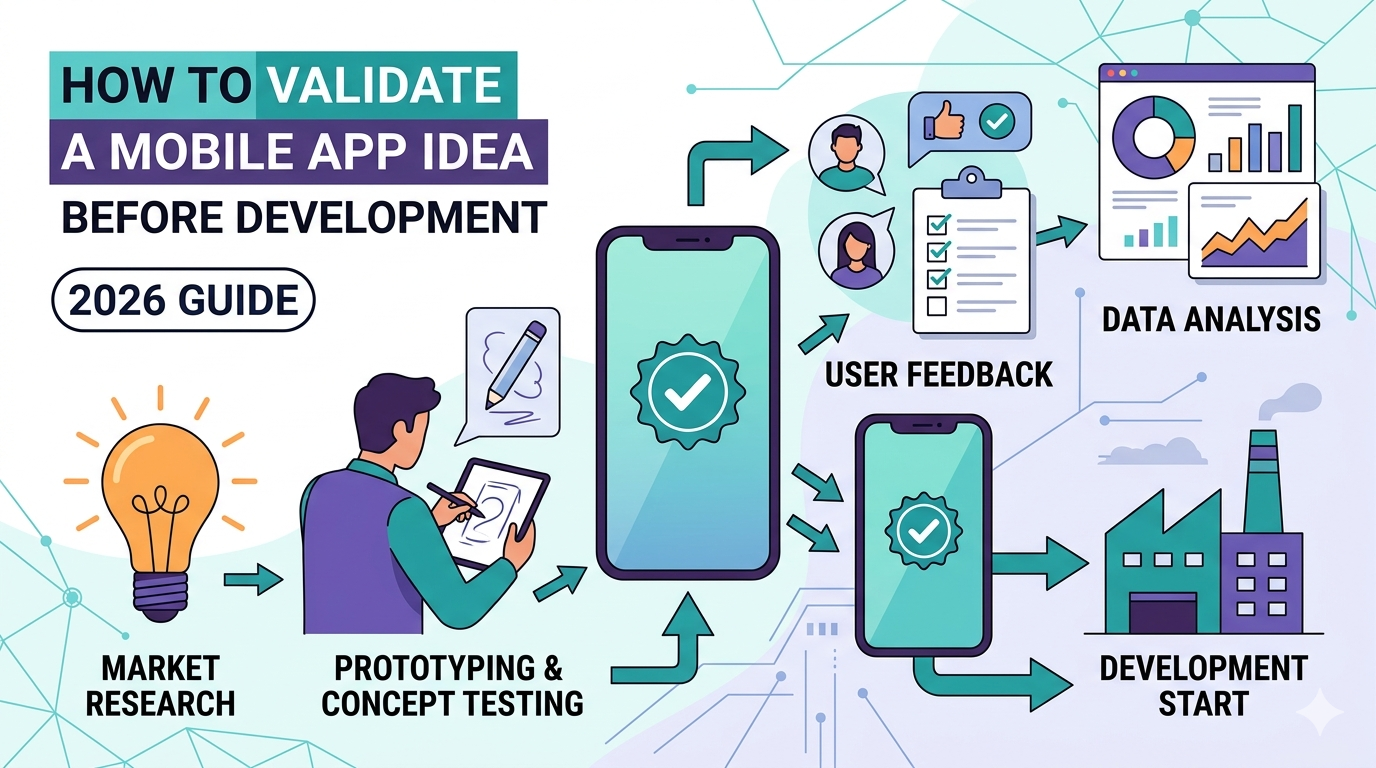
How to Validate a Mobile App Idea Before Development (2026 Guide)

How to Validate a Mobile App Idea Before Development (2026 Guide)

Most startups don’t fail because of bad development — they fail because they build something nobody actually needs.

Validating your mobile app idea before development is the single most important step in the entire startup journey. It saves you time, money, and months of wasted effort.

In this guide, you’ll learn a practical, no-fluff approach to validate your app idea before investing in development.


1. Start With the Problem, Not the App

A strong app idea always starts with a real problem.

Ask yourself:

  • What pain point am I solving?
  • How are people solving it today?
  • Why is the current solution not good enough?

If you can’t clearly define the problem, your app idea is not ready.

👉 Many founders skip this and jump straight to features — which leads to failure.
Read: Common Mistakes Startups Make When Building Their First App


2. Define Your Target Audience Clearly

“Everyone” is not a target audience.

Be specific:

  • Age group
  • Location (US, global, niche market)
  • Profession or lifestyle
  • Behavior patterns

Example:
Instead of “fitness app”, define:
→ “Busy professionals in the US who want 20-minute home workouts”

The more specific your audience, the easier validation becomes.


3. Analyze Competitors (Market Validation Shortcut)

If competitors exist, that’s a good sign — it means there’s demand.

Look at:

  • App Store & Play Store reviews
  • Feature gaps
  • Pricing models
  • User complaints

Your goal:
👉 Find what users hate — and build something better.

Also read: What Makes a Successful Mobile App Lessons From Real Products


4. Create a Simple Landing Page

Before building the app, build interest.
A landing page should include:

  • Problem statement
  • Your solution
  • Key benefits
  • Call-to-action (Join waitlist / Early access)

Tools:

  • Webflow
  • Framer
  • WordPress

Validation metric:

  • Conversion rate (5–15% is a strong signal)

If nobody signs up, your idea likely needs refinement.


5. Run Small Paid Ads (Fastest Validation Method)

This is one of the most underrated strategies.
Run ads on:

  • Facebook / Instagram
  • Google Ads

Target your ideal audience and measure:

  • Click-through rate (CTR)
  • Cost per signup
  • Engagement

👉 If people are willing to click and sign up, your idea has potential.


6. Talk to Real Users (This Changes Everything)

This is where real validation happens.

Talk to at least 10–20 potential users and ask:

  • How do you currently solve this problem?
  • What frustrates you the most?
  • Would you pay for a better solution?

You’ll often realize:
👉 Your original idea needs adjustments — and that’s a good thing.


7. Build a No-Code or Prototype Version

Before full-scale development, create a prototype or no-code MVP.

Options:

  • Figma prototype
  • Glide / Bubble (no-code apps)

Goal:

  • Test user flow
  • Validate usability
  • Get early feedback

👉 This step prevents expensive mistakes during development.


8. Define Your MVP (Only What Matters)

Once validated, define your MVP.

Focus on:

  • Core feature only
  • Essential user journey
  • Fast launch

Avoid:

  • Extra features
  • Complex backend
  • Over-engineering

👉 Learn how to define MVP correctly:
MVP App Development Features Yoou Actually Need And What To Skip
StartUp MVP Development Guide From Idea To Launch


9. Estimate Cost Before You Build

Validation also means understanding if your idea is financially viable.

Questions to ask:

  • How much will development cost?
  • Can I recover this cost?
  • What’s the revenue model?

👉 Cost breakdown: Mobile App Development Cost 2026 – Complete Pricing Breakdown
Also consider ways to reduce cost: How To Reduce Mobile App Development Cost Without Sacrificing Quality


10. Choose the Right Platform for Testing

You don’t need to build everything at once.

  • Start with iOS for US audience validation
  • Use cross-platform if budget is tight
  • Expand later based on traction

👉 Platform decision guide:
iOS Vs Android Development Which Is Better For Your App In 2026
Native Vs Cross-Platform App Development – Pros/Cons and Costs


11. Validate Willingness to Pay (Critical Step)

Many ideas get users — but no revenue.

Test:

  • Paid early access
  • Subscription interest
  • Pre-orders

👉 If users won’t pay, you don’t have a business yet — just an idea.


12. Prepare for Development Only After Validation

Once your idea is validated:

  • Finalize features
  • Choose tech stack
  • Hire developers
  • Start development

👉 Development process: Mobile App Development Process – Step By Step Guide
👉 Hiring guide: How To Hire The Right Mobile App Development Company – 2026 Guide
👉 Tech stack: Best Tech-Stack For Mobile App Development In 2026


Final Thoughts

Validating your mobile app idea is not optional — it’s mandatory.

Without validation:

  • You’re guessing

With validation:

  • You’re building with confidence

The smartest founders don’t start with development.
They start with proof.


How to Hire the Right Mobile App Development Company (2026 Guide)

How to Hire the Right Mobile App Development Company

Hiring a mobile app development company is one of the most critical decisions you’ll make for your startup or business. The right partner can accelerate your product, reduce costs, and help you scale. The wrong one can burn your budget, delay your launch, and leave you with a product that doesn’t work.

This guide breaks down exactly how to choose the right mobile app development company — without wasting time or money.


1. Start With Clarity: What Are You Building?

Before you even start searching for a mobile app development company, you need clarity on your product.

Define:

  • Your app idea
  • Target audience
  • Core features (MVP scope)
  • Budget range
  • Timeline expectations

If you’re still figuring this out, start here: How to turn your startup idea into a mobile app – 2026 Guide

👉 Companies can guide you, but they shouldn’t discover your idea for you.


2. Decide What Type of Company You Need

Not all app development companies are the same. Choosing the wrong type can cost you months.

Common options:

1. Freelancers

  • Lower cost
  • Good for very small projects
  • Risk: reliability, scalability

2. In-house team

  • Full control
  • Expensive and slow to build

3. Development agency (Recommended)

  • Structured process
  • Full team (design, development, QA)
  • Faster delivery

👉 For most startups and businesses, a mobile app development agency or remote development company is the best choice.

Read more: Hire Remote Developers – Practical Guide For Startups businesses


3. Evaluate Their Portfolio (Not Just UI)

A good-looking app doesn’t mean good engineering.

When reviewing a company:

  • Check live apps on App Store / Play Store
  • Look at performance (speed, crashes, UX)
  • Evaluate complexity (APIs, real-time features, scaling)

Ask:

  • Have they built apps similar to yours?
  • Do they have experience in your industry?

👉 Strong portfolios show problem-solving ability, not just design.


4. Understand Their Development Process

A reliable mobile app development company will always follow a structured process.

Typical flow:

  1. Discovery & requirement gathering
  2. Wireframing & UI/UX
  3. Development
  4. Testing & QA
  5. Deployment

👉 If a company jumps straight to coding, that’s a red flag.

Detailed process: Mobile App Development Process – Step By Step Guide


5. Check Their Technical Expertise

The right company should guide you on:

  • iOS vs Android strategy
  • Native vs cross-platform development
  • Tech stack decisions

👉 If they just say “we do everything,” dig deeper.

Helpful reads:
iOS Vs Android Development – Which is better for your app in 2026
Native Vs Cross-Platform App Development – Pros/Cons and Costs
Best Tech-Stack for Mobile App Development in 2026


6. Ask About Cost — But Focus on Value

Cost matters, but choosing the cheapest option often leads to higher long-term costs.

Typical US market pricing (competitive range):

  • MVP: $15,000 – $30,000
  • Mid-level app: $30,000 – $80,000
  • Complex app: $80,000 – $150,000+

👉 The key is ROI, not just price.

Understand pricing in detail: Mobile App Development Cost 2026 – Complete Pricing Breakdown


7. Understand Timeline Expectations

Unrealistic timelines are a major red flag.

Typical timelines:

  • MVP: 6–12 weeks
  • Full app: 4–8 months

👉 If someone promises a full app in 2–3 weeks, expect quality issues.
Read more: How long it takes to build a mobile app – 2026 Guide


8. Evaluate Communication & Transparency

This is where most projects fail.

Check:

  • How quickly they respond
  • How clearly they explain things
  • Whether they ask the right questions

You want a partner who:

  • Challenges your assumptions
  • Suggests better solutions
  • Keeps you updated regularly

👉 Good communication = fewer delays + better product.


9. Ask About Post-Launch Support

Your app doesn’t end at launch.

You’ll need:

  • Bug fixes
  • Updates
  • Performance optimization
  • New features

👉 Make sure the company offers long-term support.
Learn more: App Maintenance costs – What happens after launch ?


10. Look for Startup Experience (This Matters More Than You Think)

Startups move fast. Requirements change. Priorities shift.

A company experienced with startups will:

  • Focus on MVP first
  • Avoid overengineering
  • Help you iterate quickly

👉 This can save you months of time and thousands of dollars.

Recommended read:
MVP App Development Features You Actually Need And What To Skip
StartUp MVP Development Guide – From Idea to Launch


11. Watch for Red Flags

Avoid companies that:

  • Promise unrealistically low pricing
  • Guarantee timelines without understanding scope
  • Skip discovery phase
  • Have no real portfolio
  • Don’t discuss scaling or maintenance

👉 These are signs of inexperienced or unreliable teams.

Also read: Common Mistakes Startups Make When Building Their First App


12. Think Long-Term: Can They Scale With You?

Your app will grow — your development partner should too.

Ask:

  • Can they handle scaling to 100K+ users?
  • Do they understand backend architecture?
  • Can they support future features?

👉 Scaling matters more than initial development.

Scaling guide: How to Scale a Mobile App After 10K/100K/1m Users


Final Thoughts

Hiring the right mobile app development company is not about finding the cheapest option — it’s about finding the right partner.

The best companies:

  • Understand your business
  • Guide your decisions
  • Build scalable products
  • Help you grow after launch

If you choose wisely, your development partner becomes a long-term asset — not just a vendor.

How to Turn Your Startup Idea Into a Mobile App (2026 Guide)

How to Turn Your Startup Idea Into a Mobile App

Turning a startup idea into a successful mobile app is not about coding first — it’s about clarity, validation, and execution. Most startups fail not because of poor development, but because they skip the fundamentals.

In this guide, we’ll break down a practical, step-by-step approach to transform your idea into a scalable mobile app, while keeping development costs, timelines, and risks under control.


1. Validate Your Startup Idea First (Don’t Skip This)

Before writing a single line of code, validate your idea.

Ask yourself:

  • What exact problem am I solving?
  • Who is my target user?
  • Why would someone switch to my app?

Validation methods:

  • Landing page with signup waitlist
  • Competitor research
  • Talking to real users
  • Running small paid ads

👉 If you skip this, you risk building something nobody wants — one of the most common startup mistakes.
Read more : Common mistakes startups make when building their first app


2. Define Your MVP (Minimum Viable Product)

An MVP is not a “basic version” — it’s the smallest version of your app that delivers real value.

Focus on:

  • 1 core feature
  • 1 user journey
  • 1 target audience

Avoid:

  • Feature overload
  • Fancy UI early on
  • Trying to compete with established apps

👉 The goal is speed + learning, not perfection.

Detailed guide:
1. MVP App Development Features You Actually Need and What To Skip
2. Startup MVP Development Guide From Idea to Launch


3. Choose the Right Platform (iOS, Android, or Both?)

This decision directly impacts your cost and timeline.

Go with iOS first if:

  • Your audience is premium
  • You want faster development
  • You’re testing early-stage idea

Go with Android first if:

  • You’re targeting mass users (India, SEA)
  • Budget is limited

Go cross-platform if:

  • You need both platforms quickly
  • You want to reduce development cost

👉 Read full comparison:
1. iOS Vs Android Development Which is better for your app in 2026
2. Native Vs Cross-Platform App Development – Pros/Cons and Costs


4. Decide the Right Tech Stack

Your tech stack determines:

  • Performance
  • Scalability
  • Maintenance cost

Typical modern stack (2026):

  • Frontend: SwiftUI / Kotlin / Flutter
  • Backend: Node.js / Firebase / Supabase
  • Database: PostgreSQL / Firestore

👉 Full breakdown:
Best Tech-Stack For Mobile App Development in 2026


5. Estimate Cost & Timeline

This is where most founders get surprised.

Typical US market pricing (competitive, below average):

  • Basic MVP app: $15,000 – $30,000
  • Mid-level app (API integrations, dashboards): $30,000 – $80,000
  • Complex app (real-time, AI, scaling systems): $80,000 – $150,000+

Timeline:

  • MVP: 6–12 weeks
  • Full product: 4–8 months

👉 Detailed breakdown:
1. Mobile App Development Cost In 2026 – Complete Pricing Breakdown
2. How long does it take to build a mobile app – 2026 Guide


6. Hire the Right Development Team

You have three main options:

  • Freelancers
  • In-house team
  • Remote development agency

For US startups, remote development teams offer the best balance:

  • Lower cost than US agencies
  • High-quality engineering
  • Faster turnaround

👉 Hiring guide: Hire Remote Developers Guide For Startup Businesses


7. Follow a Structured Development Process

A proper mobile app development process looks like this:

  1. Requirement gathering
  2. Wireframes & UI/UX design
  3. Development (frontend + backend)
  4. Testing & QA
  5. Deployment (App Store + Play Store)

👉 Full process explained: Mobile App Development Process – Step by Step Guide


8. Launch Fast, Then Iterate

Your first version is not your final product.

After launch:

  • Track user behavior
  • Collect feedback
  • Improve features

👉 Successful apps evolve continuously, not perfectly at launch.

Learn what makes apps successful: What makes a successful mobile app – lessons from real products


9. Plan for Post-Launch Costs

Many founders overlook this.

Ongoing costs (US market):

  • Maintenance: $1,000 – $5,000/month
  • Cloud hosting: $200 – $2,000+/month
  • Feature updates: variable

👉 Learn more: App Maintenance costs – What happens after launch?


10. Scale Your App as You Grow

Scaling is not just technical — it’s strategic.

At different stages:

  • 10K users: Optimize performance
  • 100K users: Improve backend architecture
  • 1M users: Invest in infrastructure & analytics

👉 Scaling guide: How to Scale a Mobile App After 10K/100K/1m Users


11. Optimize Costs Without Sacrificing Quality

Smart startups don’t overspend — they optimize.

Cost-saving strategies:

  • Start with MVP
  • Use cross-platform when appropriate
  • Hire remote teams instead of full US in-house
  • Focus only on revenue-driving features

👉 Read more: How to reduce mobile app development cost without sacrificing quality


Final Thoughts

Turning your startup idea into a mobile app is not a one-step process — it’s a journey:

Idea → Validation → MVP → Launch → Scale

The difference between failed and successful startups isn’t just the idea — it’s execution speed, cost efficiency, and continuous improvement.

If you approach it correctly, your app doesn’t just get built — it becomes a scalable business.


How to Reduce Mobile App Development Cost Without Sacrificing Quality

* How to Reduce Mobile App Development Cost Without Sacrificing Quality

Reducing mobile app development cost without compromising quality is one of the biggest challenges for startups and businesses in 2026.

With rising development rates and increasing user expectations, building an app can quickly become expensive. However, the reality is—you don’t need a massive budget to build a successful product.

By making the right technical and strategic decisions, you can significantly lower your mobile app development cost while still delivering a high-performance, scalable app.


1. Start With a Clear MVP (Not a Full Product)

One of the most effective ways to reduce mobile app development cost is by starting with a Minimum Viable Product (MVP).
Instead of building a full-featured app, focus only on the core functionality.

👉 If you’re unsure what to include, check this: MVP App Development – Features you actually need and what to skip

Why it works:
  • Reduces initial app development cost
  • Speeds up time to market
  • Helps validate your idea early

An MVP-first approach can reduce your mobile app development cost by up to 60%.


2. Choose the Right Development Approach

our development approach directly affects your mobile app development cost.
👉 Read detailed comparison: Native Vs Cross Platform – App Development Pros, cons and Costs

Options:
  • Native (Swift/Kotlin) → Higher app development cost, better performance
  • Cross-platform (Flutter/React Native) → Lower mobile app development cost, faster delivery

If performance requirements are moderate, cross-platform development is often the most cost-efficient choice.


3. Launch on One Platform First

Trying to build for both iOS and Android at once can significantly increase your mobile app development cost.
👉 See platform comparison: iOS Vs Android Development – Which is better for your app in 2026 ?

Strategy:
  • Start with one platform
  • Validate user demand
  • Expand later

This approach minimizes risk and keeps your app development cost under control.


4. Hire Remote Developers

Hiring strategy plays a major role in determining your mobile app development cost.
👉 Practical hiring guide: Hire Remote Developers In India – Practical Guide For Startups

Working with remote developers, especially in regions like India, can significantly reduce your app development cost without affecting quality.

Benefits:
  • Lower hourly rates
  • Access to skilled developers
  • Flexible scaling

Many startups reduce development costs by 30–70% by working with experienced remote teams.


5. Avoid Overengineering

Overengineering is one of the most common reasons for increased mobile app development cost.
👉 Learn the full development flow: Mobile App Development Process – Step by Step Guide

Better approach:
  • Build only what is needed
  • Keep architecture simple
  • Optimize later

    This ensures your app development cost stays aligned with actual business needs.

6. Use Pre-built Solutions

Building everything from scratch increases your mobile app development cost unnecessarily.
👉 Explore modern stacks: Best Tech-Stack for Mobile App Development in 2026

Use:
  • Firebase for backend
  • Stripe/Razorpay for payments
  • Third-party APIs

This reduces both development time and overall app development cost.


7. Finalize UI/UX Early

Frequent design changes during development can increase your mobile app development cost drastically.
👉 Common mistakes to avoid: Common Mistakes Startups Make When Building Their First App

Tip:
  • Lock design before development
  • Use prototypes
  • Validate early

This alone can save weeks of rework.


8. Plan for Maintenance Costs

Your mobile app development cost doesn’t end at launch.
👉 Learn more: App Maintainance Costs – What happens after launch ?

Ongoing costs include:
  • Bug fixes
  • Server costs
  • Updates
  • Performance optimization

Plan for 15–25% of your initial app development cost annually.


9. Scale Gradually

Building for massive scale from day one increases your mobile app development cost unnecessarily.
👉 Scaling guide: How To Scale a Mobile App After 10K – 100K – 1m Users.

Smart scaling:
  • Start lean
  • Upgrade as users grow
  • Optimize only when needed

Start small and scale based on real usage to optimize your app development cost.


10. Understand the Real Cost Breakdown

To manage your mobile app development cost, you need visibility into where your budget goes.
👉 Full cost breakdown here: Mobile App Development Cost In 2026: Complete Pricing Breakdown

Typical cost distribution:
  • Design: 10–15%
  • Development: 50–60%
  • Backend: 15–20%
  • Testing: 10–15%

Understanding this helps you allocate budget wisely.


Final Thoughts

Reducing mobile app development cost is not about cutting corners—it’s about making smarter decisions.

With the right approach, you can:

  • Lower your app development cost
  • Build faster
  • Maintain high quality

You can build a high-quality app without burning your budget.


What Makes a Successful Mobile App? Lessons From Real Products

What Makes a Successful Mobile App? Lessons From Real Products

Every year, thousands of mobile apps are launched — but only a small percentage actually succeed.

Some apps gain millions of users, scale globally, and generate revenue. Others struggle with low engagement, poor retention, and eventually fade away.

So what separates a successful mobile app from one that fails?

After working with startups and businesses on mobile app development, MVPs, and scaling products, we’ve seen clear patterns. In this article, we break down what actually makes a mobile app successful, based on real-world product experience — not theory.

1. Successful Apps Solve One Clear Problem

The most successful mobile apps are simple at their core.
They don’t try to do everything. They focus on one strong value proposition.

Examples:

  • Uber → Book a ride instantly
  • WhatsApp → Simple, fast messaging
  • Airbnb → Find and book stays

If your app cannot clearly answer:
👉 “Why would someone use this app?”
…it will struggle to gain traction.

This is exactly why most startups begin with an MVP. If you’re still shaping your idea, start with our
👉 Startup MVP Development Guide

2. Great User Experience (UX) Wins Every Time

A successful mobile app is not just functional — it is easy and intuitive to use.

Users expect:

  • Fast loading screens
  • Smooth navigation
  • Clear actions
  • Minimal friction

If users have to “figure out” your app, they will leave.

In fact, many apps fail not because of bad ideas, but because of poor UX design and usability issues.

👉 If you’re building your first app, avoid these pitfalls:
Common Mistakes Startups Make When Building Their First App

3. Performance and Stability Are Non-Negotiable

No matter how good your idea is, if your app:

  • crashes
  • lags
  • drains battery
  • or freezes

users will uninstall it.

Modern users expect apps to be:

  • fast
  • stable
  • responsive

This is where choosing the right mobile app tech stack and architecture becomes critical.
👉 Learn more about this here:
Best Tech Stack for Mobile App Development in 2026

4. Strong MVP First, Then Smart Scaling

Successful apps don’t launch with 50 features.
They start with:

  • a focused MVP
  • real user feedback
  • rapid iterations

Many failed apps made the mistake of overbuilding too early.
👉 If you’re planning features, read: MVP App Development: Features You Actually Need

Once the app gains traction, scaling becomes the next challenge.
👉 Scaling strategy matters a lot: How to Scale a Mobile App

5. Choosing the Right Platform Strategy

One common question founders ask:
👉 Should we build for iOS, Android, or both?

The answer depends on:

  • target audience
  • budget
  • timeline
  • monetization strategy

Choosing the wrong platform can delay growth.
👉 If you’re deciding this, read: iOS vs Android Development Guide

Also consider whether native or cross-platform makes more sense:
👉 Native vs Cross-Platform Development

6. Continuous Improvement After Launch

A successful mobile app is never “done.”

After launch, you must:

  • fix bugs
  • release updates
  • improve features
  • optimize performance

Many founders underestimate this phase.
👉 Understand what happens after launch: App Maintenance Costs Guide

Apps that don’t evolve quickly lose users to competitors.

7. Clean Architecture & Long-Term Thinking

Apps that succeed long-term are built with:

  • clean architecture
  • scalable backend
  • modular code
  • maintainable systems

If you skip this early, you may eventually need a rewrite.
👉 This is more common than you think: When Should You Rewrite Your Mobile App?

8. Realistic Budget & Planning

Many startups fail because they underestimate cost and timelines.

A successful mobile app is not just about building — it’s about planning properly.
👉 If you’re budgeting your app: Mobile App Development Cost Guide
👉 And timeline expectations: How Long Does It Take to Build an App?

9. The Right Development Partner Matters

Even with a great idea, poor execution can kill a product.
Successful apps are built by teams that understand:

  • product thinking
  • scalability
  • user behavior
  • long-term architecture

Many businesses choose to work with experienced teams or hire remote developers.
👉 If you’re exploring that: Hire Remote Developers in India

Final Thoughts: Success Is Built, Not Luck

Successful mobile apps are not built by chance.

They are built through:

  • clear problem-solving
  • strong execution
  • continuous improvement
  • smart technical decisions

If you focus on:

  • user experience
  • performance
  • scalability
  • and real-world usage

you dramatically increase your chances of success.

Native vs Cross-Platform App Development: Pros, Cons & Costs

In today’s digital economy, choosing the right mobile app development approach can determine whether your product becomes a market leader or an expensive failure. One of the most critical decisions businesses face is whether to build a Native app or a Cross-Platform app.

If you are planning to build a mobile product, our mobile app development services help startups and enterprises choose the right technology from day one.

This guide will help you understand the difference between Native and Cross-Platform app development, their pros and cons, development costs, and which approach is best for your business in 2025.

💡 Not sure which approach is right for your idea?
👉 Get a free consultation with our app experts

What Is Native App Development?

Native app development means building an application specifically for one operating system.

PlatformProgramming Language
iOSSwift, Objective-C
AndroidKotlin, Java

Native apps directly interact with the device’s operating system, hardware, and UI components.

If you are targeting premium performance or App Store rankings, our iOS app development and Android app development teams specialize in high-performance native builds.

🚀 Building a high-performance mobile app?
👉 Talk to our iOS & Android development team

What Is Cross-Platform App Development?

Cross-platform development allows developers to write one codebase that runs on multiple platforms like iOS and Android.

Popular cross-platform frameworks include:

  • Flutter
  • React Native
  • Xamarin
  • Ionic

This approach focuses on code reusability and faster development.
Our cross-platform app development services are ideal for startups that need to launch quickly with a limited budget.

⏱ Want to launch your app faster?
👉 Get a cross-platform MVP estimate

Native vs Cross-Platform: Key Differences

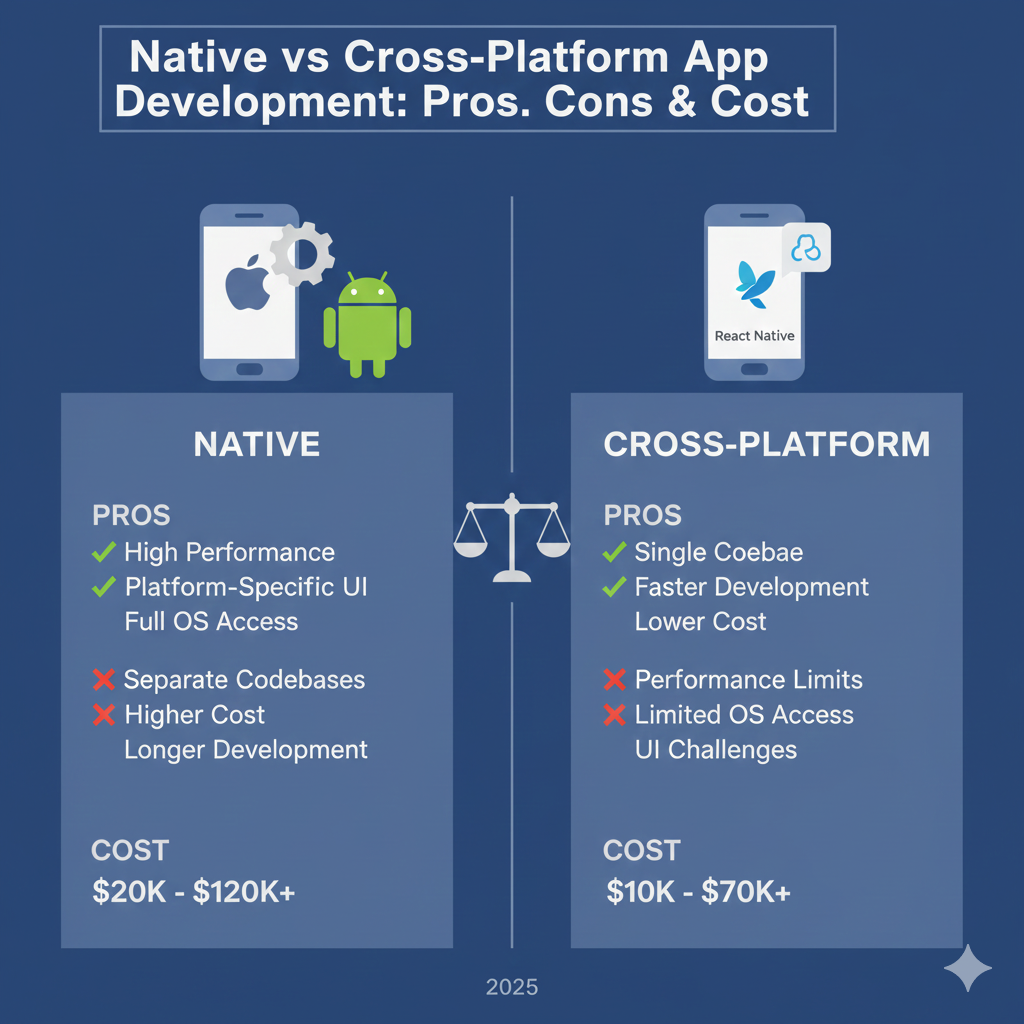
FeatureNative AppsCross-Platform Apps
PerformanceExcellentModerate To High
User ExperienceBestGood
Development TimeLongerFaster
CostHigherLowest
Hardware AccessFullLimited
App SizeSmallerLarger
UI ResponsivenessNative SmoothSlightly Slower
MaintenanceSeparate CodebasesSingle Codebase

📊 Want to know which option fits your budget and timeline?
👉 Request a free project estimate

Pros of Native App Development

1. Best Performance

Native apps are compiled directly into machine code, making them extremely fast and responsive.

2. Superior User Experience

They follow platform-specific design guidelines (Material Design for Android, Human Interface Guidelines for iOS).

3. Full Access to Device Features

You can access GPS, Bluetooth, camera, biometrics, and system APIs without limitations.

4. Higher App Store Ranking

Google Play and Apple App Store prefer fast, stable native apps, which improves your ASO and SEO ranking — one reason many enterprises choose native mobile app development.

Cons of Native App Development

  • Higher development cost
  • Two separate teams required (iOS + Android)
  • Longer time to market
  • More expensive maintenance

Pros of Cross-Platform App Development

1. Lower Development Cost

One codebase for two platforms reduces engineering expenses by up to 40–50%.

2. Faster Time to Market

Develop once, deploy everywhere.

3. Easier Maintenance

Fix a bug once and it works on both iOS and Android.

4. Ideal for MVPs & Startups

Cross-platform frameworks are perfect for validating ideas before investing in full native app development.

Cons of Cross-Platform Development

  • Slightly lower performance
  • UI may not feel fully native
  • Limited access to advanced APIs
  • Depends heavily on third-party frameworks

Cost Comparison: Native vs Cross-Platform Apps

App TypeNative CostCross Platform Cost
Simple App$15,000 – $30,000$8,000 – $18,000
Medium App$40,000 – $80,000$25,000 – $50,000
Complex App$100,000+$60,000 – $120,000

Native apps cost more because you must build and maintain two separate codebases — one for iOS and one for Android.

💰 Want an accurate cost for your app?
👉 Get a personalized cost breakdown

Which Is Better for SEO & User Retention?

If you want:

  • Better reviews
  • Faster loading
  • Lower crash rate
  • Higher App Store ranking

👉 Native apps win

If you want:

  • Lower budget
  • Faster launch
  • MVP or startup product

👉 Cross-platform wins

🎯 Still unsure which is right for your product?
👉 Speak to our app strategy team

FeatureNativeFlutterReact Native
PerformanceBestHighMedium
App SizeSmallLargeMedium
UI QualityBestGoodGood
Dev SpeedSlowFastFast
Best ForEnterprise appsMVPsSocial apps

Which Should You Choose in 2025?

Choose Native if:

  • You are building a fintech, health, or gaming app
  • You need top performance
  • You want long-term scalability

Choose Cross-Platform if:

  • You are building a startup MVP
  • You want to save money
  • You need quick market validation

If you are unsure, our mobile app development consultants can help you choose the right architecture based on your business goals.

Final Verdict

There is no universal winner.

  • Native apps are best for quality, performance, and long-term success.
  • Cross-platform apps are best for speed, cost, and MVPs.

Your choice should depend on:

  • Budget
  • Timeline
  • App complexity
  • Business goals

iOS vs Android Development: Which Is Better for Your App in 2026?

Choosing between iOS vs Android development is one of the most important decisions founders and businesses make when building a mobile app. The right platform impacts your development cost, time-to-market, monetization, and long-term scalability.

Quick Answer: iOS vs Android — Which Is Better?

There is no one-size-fits-all answer. The better platform depends on your target audience, budget, business goals, and growth strategy.

  • iOS development is ideal for premium users, faster MVPs, and higher monetization.
  • Android development works best for mass adoption and global reach.

Market Share & Audience Differences

Android Market Share

Android dominates global smartphone usage, especially in India, Southeast Asia, Africa, and South America. If your app targets large-scale adoption or emerging markets, Android is often the preferred platform.

iOS Market Share

While iOS has a smaller global market share, its users tend to spend more on apps and subscriptions. iOS performs particularly well in the US, Canada, Europe, and Australia.

Development Cost Comparison

iOS App Development Cost

iOS apps are typically faster to build due to fewer device variations and a controlled ecosystem. This often results in lower MVP costs and quicker launches.

Android App Development Cost

Android development involves supporting many devices, screen sizes, and OS versions. While initial development can be affordable, testing and maintenance costs may increase over time.

At Nerdware Labs, most startup MVPs we build typically fall between $10,000 and $40,000, depending on scope, features, and platform. If you want a deeper breakdown of pricing, timelines, and hidden costs, read our detailed guide on how much it costs to build a mobile app .

Development Speed & Time to Market

iOS Development Speed

Swift and SwiftUI allow faster iteration, cleaner architecture, and predictable testing. This makes iOS ideal for startups racing to launch an MVP.

Android Development Speed

Kotlin and Jetpack Compose are powerful, but Android apps require more QA due to device fragmentation. This can extend timelines slightly.

UI/UX & Design Consistency

Apple’s Human Interface Guidelines create consistent user experiences across iOS devices, making it easier to deliver polished UX. Android offers more design freedom but introduces additional complexity.

App Store Approval & Distribution

Apple App Store

Apple enforces stricter review guidelines, resulting in higher-quality apps and stronger user trust.

Google Play Store

Google Play approvals are faster and more flexible, making Android suitable for rapid experimentation and iteration.

Monetization & Revenue Potential

iOS users are more willing to pay for apps and subscriptions, while Android apps often perform better with ad-based monetization and large install volumes.

Security & Performance

iOS benefits from a closed ecosystem and faster OS adoption, making it a strong choice for fintech, healthcare, and enterprise apps. Android security has improved significantly but still varies by device manufacturer.

Should You Build Cross-Platform?

Cross-platform frameworks can reduce time and cost, but native development often delivers better performance and long-term scalability. Many startups begin with one platform before expanding.

Final Verdict: Which Platform Should You Choose?

  • Choose iOS for faster MVPs, premium users, and subscriptions.
  • Choose Android for global reach and mass adoption.
  • Choose both when your product is validated and ready to scale.

Need expert guidance on choosing the right platform? Our mobile app development team helps startups make the right technical decisions from day one.