
Hire Remote Developers in India: Cost, Benefits & Risks (2026 Guide)

Hire Remote Developers in India: Cost, Benefits & Risks

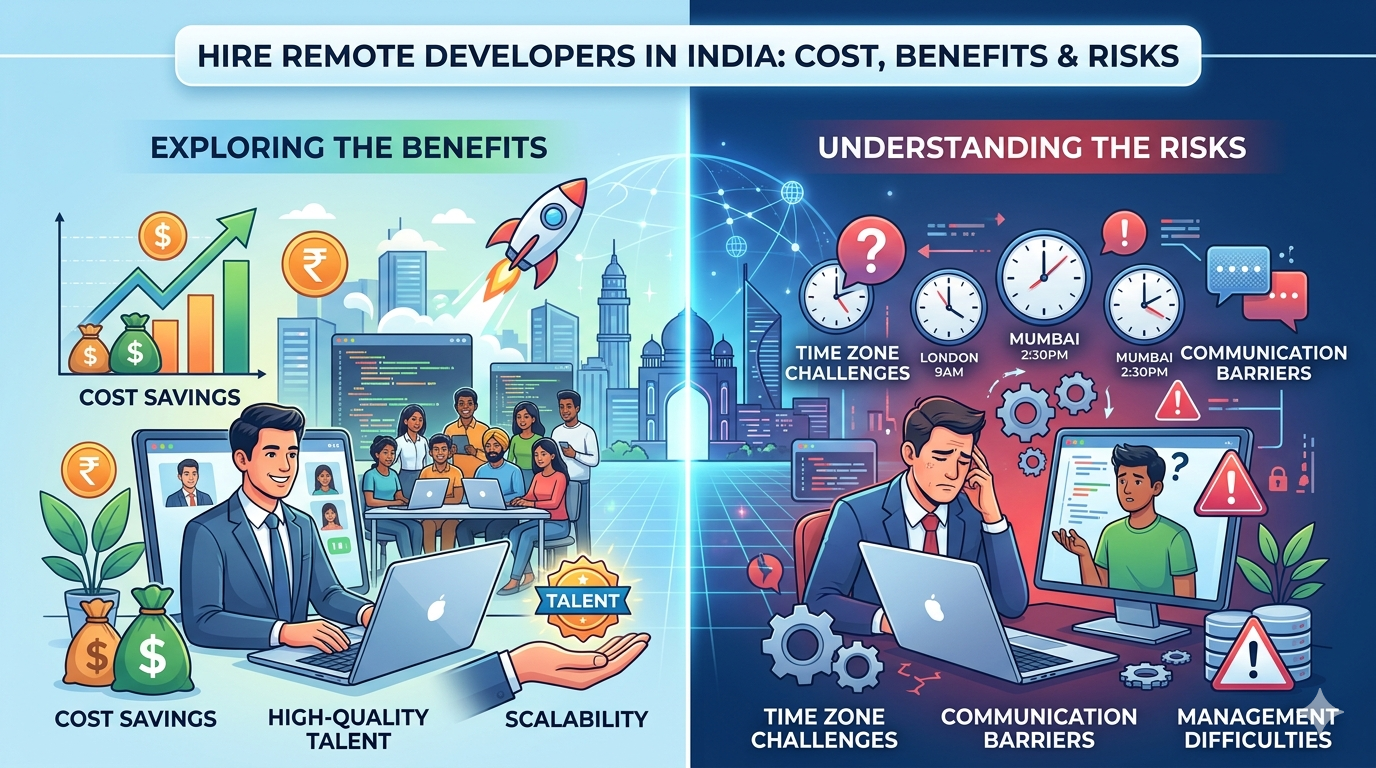
Hiring remote developers in India is no longer just about cutting costs—it’s about building high-quality products faster with access to a global talent pool. In 2026, startups and businesses are increasingly relying on Indian developers for everything from MVPs to large-scale applications.

But is it the right move for you?

Let’s break down the real costs, advantages, and risks, so you can make an informed decision.


Why India Remains the Top Choice for Remote Developers

India has positioned itself as a global tech hub for a reason. With millions of skilled developers, strong English communication, and deep expertise in mobile and backend technologies, it offers a practical solution for companies looking to scale efficiently.

For many startups, especially those building their first product, hiring remote teams becomes the fastest way to go from idea to execution.

If you’re still comparing models, this breakdown helps:
👉 In-house Vs Remote Developers : Practical Cost Comparison For Modern Businesses


Cost of Hiring Remote Developers in India (2026)

Cost is often the primary driver—but it’s important to understand it correctly.

Average Pricing
  • Junior developers: $10–$20/hour
  • Mid-level developers: $20–$40/hour
  • Senior developers: $40–$80/hour

In monthly terms, that translates roughly to:

  • $1,500 – $3,000 (junior)
  • $3,000 – $6,000 (mid-level)
  • $6,000 – $12,000 (senior)

Compared to US or European developers, this is typically 50–70% more affordable.

However, total cost isn’t just hourly rate—it includes planning, design, testing, and maintenance. If you want a full breakdown of app-level costs:
👉 Mobile App Development Cost: 2026 Complete Pricing Breakdown


Key Benefits of Hiring Remote Developers in India

1. Cost Efficiency Without Compromising Quality

You can build an entire product team at the cost of hiring one or two local developers in Western markets. This makes it especially useful for startups working with limited budgets.


2. Access to Specialized Talent

India has deep expertise across:

  • iOS (Swift, SwiftUI)
  • Android (Kotlin, Jetpack Compose)
  • Cross-platform (Flutter, React Native)
  • Backend (Node.js, Python, Go)

This allows you to hire exactly what you need instead of settling for generalists.


3. Faster Development Cycles

Remote teams can be scaled quickly, which directly impacts time-to-market. Instead of spending months hiring locally, you can onboard developers within days.

If timelines matter for your project:
👉 How Long Does It Take To Build a Mobile App: 2026 Guide


4. Ideal for MVP Development

If you’re building an MVP, speed and cost matter more than perfection. Remote developers help you launch faster and validate ideas without heavy investment.

👉 MVP App Development Features You Actually Need and What To Skip


5. Flexibility and Scalability

You can scale your team up or down depending on your needs—something that’s difficult with in-house hiring.


Risks of Hiring Remote Developers in India

While the benefits are strong, there are real risks if not managed properly.


1. Communication Gaps

Even with good English proficiency, unclear requirements can lead to mismatched expectations.

Solution:

  • Write detailed specs
  • Use tools like Jira or Notion
  • Define clear deliverables

2. Quality Variability

The biggest mistake companies make is hiring based only on cost. Cheap developers often lead to poor code quality and technical debt.

Avoid this common mistake:
👉 Common Mistakes Startups Make When Building Their First App


3. Time Zone Differences

India operates in IST, which may not fully overlap with US or European time zones.

Solution:

  • Ensure at least 2–4 hours overlap
  • Use async communication
  • Schedule fixed sync meetings

4. Hidden Long-Term Costs

If the architecture is weak or shortcuts are taken, you’ll pay later in maintenance and rewrites.

👉 App Maintenace Costs: What happens after launch


When Hiring Remote Developers Makes Sense

Hiring remote developers in India is the right choice if:

  • You’re building an MVP
  • You want to reduce development cost
  • You need to scale quickly
  • You don’t have an in-house tech team

However, if you’re building a highly sensitive or IP-heavy product, a hybrid approach (remote + in-house) is often safer.


How to Hire the Right Remote Developers

A structured hiring process reduces most risks:

  1. Clearly define your requirements
  2. Decide between freelancers, agencies, or dedicated teams
  3. Conduct technical interviews
  4. Start with a trial project
  5. Set up communication workflows early

If you want a step-by-step hiring process:

👉 How to hire the right mobile app development company – 2026 Guide
👉 Hire Remote Developers In India: A Practical Guide For Startups Businesses


Final Thoughts

Hiring remote developers in India in 2026 is not just a cost decision—it’s a strategic one. When done right, it allows you to build faster, reduce expenses, and access world-class talent.

But success depends on how you manage the process. Clear communication, proper hiring, and strong technical oversight make all the difference.
In-House vs Remote Developers: A Practical Cost Comparison for Modern Businesses

Hire Remote Developers in India: Cost, Benefits & Risks

When companies start scaling their tech teams, one question almost always comes up: should you hire in-house developers or go with remote developers?

At first glance, the answer seems obvious—remote developers are cheaper. But once you dig deeper, the cost comparison becomes more nuanced. This article breaks down the real costs, hidden expenses, and long-term ROI of both models so you can make a financially sound decision.


Understanding the Two Models

Before comparing costs, let’s clarify what each model means.

In-house developers are full-time employees working from your office or headquarters. They are embedded in your company culture and typically work fixed hours.

Remote developers, on the other hand, work from different locations—sometimes even different countries. They can be full-time, part-time, or contract-based.


Direct Cost Comparison

1. Salary & Compensation

The most obvious difference lies in salaries.

  • In-house developers demand higher salaries, especially in tech hubs.
  • Remote developers can be hired globally, often at significantly lower rates.

For example:

  • A senior iOS developer in the US: $120,000–$180,000/year
  • A remote developer from Eastern Europe or India: $30,000–$70,000/year

👉 This is where businesses see immediate cost savings with remote development teams.


2. Infrastructure & Office Costs

Hiring in-house isn’t just about salaries.

You also pay for:

  • Office space
  • Electricity & internet
  • Workstations & hardware
  • Office perks (food, transport, etc.)

These expenses can add 20–30% extra cost per employee.

With remote developers:

  • No office space required
  • Reduced hardware costs (often self-managed)

👉 This makes remote hiring a cost-efficient option, especially for startups.


3. Recruitment & Onboarding Costs

Hiring in-house involves:

  • Recruitment agencies
  • HR teams
  • Interview logistics
  • Onboarding programs

Remote hiring, especially through platforms or outsourcing partners, can:

  • Reduce hiring time
  • Lower recruitment costs
  • Provide pre-vetted developers

👉 Many companies now prefer remote developer hiring platforms to optimize cost and speed.


4. Employee Benefits & Compliance

In-house developers require:

  • Health insurance
  • Paid leaves
  • Retirement contributions
  • Legal compliance (taxes, labor laws)

Remote developers (especially contractors):

  • Typically don’t require benefits
  • Reduce compliance overhead

👉 This significantly lowers the total cost of ownership (TCO) for remote teams.


Hidden Costs You Shouldn’t Ignore

This is where most comparisons fall short.

In-House Hidden Costs
  • Office expansion as team grows
  • Employee attrition and rehiring
  • Productivity loss due to office distractions
Remote Hidden Costs
  • Communication gaps
  • Time zone differences
  • Need for collaboration tools
  • Management overhead

👉 If not managed properly, remote teams can incur productivity losses, offsetting cost savings.


Productivity vs Cost: The Real Trade-Off

Many businesses assume cheaper means better. That’s not always true.

In-house teams offer:

  • Better collaboration
  • Faster decision-making
  • Stronger company culture

Remote teams offer:

  • Access to global talent
  • Flexible scaling
  • Cost savings

The key question becomes:
👉 Do you want control or cost efficiency?


When In-House Developers Make Sense

Choose in-house if:

  • You’re building a core product requiring tight collaboration
  • Security and data privacy are critical
  • You need real-time decision-making
  • Long-term team stability is a priority

When Remote Developers Are the Better Choice

Go remote if:

  • You want to reduce development costs
  • You need to scale quickly
  • You’re hiring for short-term or specialized projects
  • Budget constraints are a concern

Hybrid Model: The Best of Both Worlds

Many companies today are adopting a hybrid development model:

  • Core team in-house
  • Extended team remote

This approach:

  • Balances cost and control
  • Improves scalability
  • Reduces operational risks

👉 If you’re unsure, this is often the safest starting point.


Internal Resources You Might Find Helpful

To go deeper into optimizing your development strategy, check out:


Final Verdict

There’s no one-size-fits-all answer.

  • If your priority is cost savings, remote developers clearly win.
  • If your priority is control and collaboration, in-house developers are the better choice.

However, the smartest companies don’t pick one—they combine both strategically.


Bottom Line

The decision isn’t just about cost—it’s about value per dollar spent.

Ask yourself:

  • What stage is my business in?
  • Do I need speed or stability?
  • Can I manage remote teams effectively?

Once you answer these, the right choice becomes obvious.


If you’re planning to scale your development team and want a tailored cost breakdown, it’s worth analyzing your specific use case rather than relying on generic comparisons.