
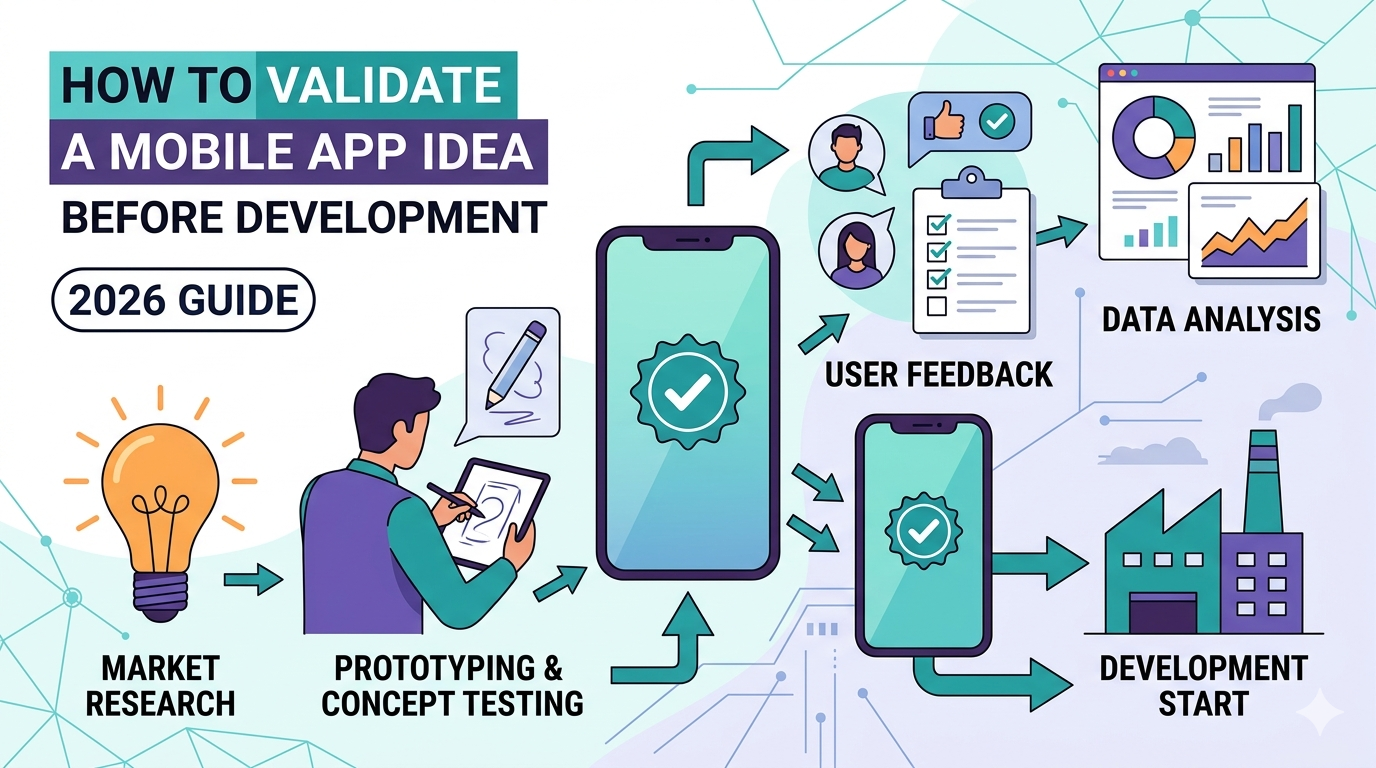
How to Validate a Mobile App Idea Before Development (2026 Guide)

How to Validate a Mobile App Idea Before Development (2026 Guide)

Most startups don’t fail because of bad development — they fail because they build something nobody actually needs.

Validating your mobile app idea before development is the single most important step in the entire startup journey. It saves you time, money, and months of wasted effort.

In this guide, you’ll learn a practical, no-fluff approach to validate your app idea before investing in development.


1. Start With the Problem, Not the App

A strong app idea always starts with a real problem.

Ask yourself:

  • What pain point am I solving?
  • How are people solving it today?
  • Why is the current solution not good enough?

If you can’t clearly define the problem, your app idea is not ready.

👉 Many founders skip this and jump straight to features — which leads to failure.
Read: Common Mistakes Startups Make When Building Their First App


2. Define Your Target Audience Clearly

“Everyone” is not a target audience.

Be specific:

  • Age group
  • Location (US, global, niche market)
  • Profession or lifestyle
  • Behavior patterns

Example:
Instead of “fitness app”, define:
→ “Busy professionals in the US who want 20-minute home workouts”

The more specific your audience, the easier validation becomes.


3. Analyze Competitors (Market Validation Shortcut)

If competitors exist, that’s a good sign — it means there’s demand.

Look at:

  • App Store & Play Store reviews
  • Feature gaps
  • Pricing models
  • User complaints

Your goal:
👉 Find what users hate — and build something better.

Also read: What Makes a Successful Mobile App Lessons From Real Products


4. Create a Simple Landing Page

Before building the app, build interest.
A landing page should include:

  • Problem statement
  • Your solution
  • Key benefits
  • Call-to-action (Join waitlist / Early access)

Tools:

  • Webflow
  • Framer
  • WordPress

Validation metric:

  • Conversion rate (5–15% is a strong signal)

If nobody signs up, your idea likely needs refinement.


5. Run Small Paid Ads (Fastest Validation Method)

This is one of the most underrated strategies.
Run ads on:

  • Facebook / Instagram
  • Google Ads

Target your ideal audience and measure:

  • Click-through rate (CTR)
  • Cost per signup
  • Engagement

👉 If people are willing to click and sign up, your idea has potential.


6. Talk to Real Users (This Changes Everything)

This is where real validation happens.

Talk to at least 10–20 potential users and ask:

  • How do you currently solve this problem?
  • What frustrates you the most?
  • Would you pay for a better solution?

You’ll often realize:
👉 Your original idea needs adjustments — and that’s a good thing.


7. Build a No-Code or Prototype Version

Before full-scale development, create a prototype or no-code MVP.

Options:

  • Figma prototype
  • Glide / Bubble (no-code apps)

Goal:

  • Test user flow
  • Validate usability
  • Get early feedback

👉 This step prevents expensive mistakes during development.


8. Define Your MVP (Only What Matters)

Once validated, define your MVP.

Focus on:

  • Core feature only
  • Essential user journey
  • Fast launch

Avoid:

  • Extra features
  • Complex backend
  • Over-engineering

👉 Learn how to define MVP correctly:
MVP App Development Features Yoou Actually Need And What To Skip
StartUp MVP Development Guide From Idea To Launch


9. Estimate Cost Before You Build

Validation also means understanding if your idea is financially viable.

Questions to ask:

  • How much will development cost?
  • Can I recover this cost?
  • What’s the revenue model?

👉 Cost breakdown: Mobile App Development Cost 2026 – Complete Pricing Breakdown
Also consider ways to reduce cost: How To Reduce Mobile App Development Cost Without Sacrificing Quality


10. Choose the Right Platform for Testing

You don’t need to build everything at once.

  • Start with iOS for US audience validation
  • Use cross-platform if budget is tight
  • Expand later based on traction

👉 Platform decision guide:
iOS Vs Android Development Which Is Better For Your App In 2026
Native Vs Cross-Platform App Development – Pros/Cons and Costs


11. Validate Willingness to Pay (Critical Step)

Many ideas get users — but no revenue.

Test:

  • Paid early access
  • Subscription interest
  • Pre-orders

👉 If users won’t pay, you don’t have a business yet — just an idea.


12. Prepare for Development Only After Validation

Once your idea is validated:

  • Finalize features
  • Choose tech stack
  • Hire developers
  • Start development

👉 Development process: Mobile App Development Process – Step By Step Guide
👉 Hiring guide: How To Hire The Right Mobile App Development Company – 2026 Guide
👉 Tech stack: Best Tech-Stack For Mobile App Development In 2026


Final Thoughts

Validating your mobile app idea is not optional — it’s mandatory.

Without validation:

  • You’re guessing

With validation:

  • You’re building with confidence

The smartest founders don’t start with development.
They start with proof.


How to Turn Your Startup Idea Into a Mobile App (2026 Guide)

How to Turn Your Startup Idea Into a Mobile App

Turning a startup idea into a successful mobile app is not about coding first — it’s about clarity, validation, and execution. Most startups fail not because of poor development, but because they skip the fundamentals.

In this guide, we’ll break down a practical, step-by-step approach to transform your idea into a scalable mobile app, while keeping development costs, timelines, and risks under control.


1. Validate Your Startup Idea First (Don’t Skip This)

Before writing a single line of code, validate your idea.

Ask yourself:

  • What exact problem am I solving?
  • Who is my target user?
  • Why would someone switch to my app?

Validation methods:

  • Landing page with signup waitlist
  • Competitor research
  • Talking to real users
  • Running small paid ads

👉 If you skip this, you risk building something nobody wants — one of the most common startup mistakes.
Read more : Common mistakes startups make when building their first app


2. Define Your MVP (Minimum Viable Product)

An MVP is not a “basic version” — it’s the smallest version of your app that delivers real value.

Focus on:

  • 1 core feature
  • 1 user journey
  • 1 target audience

Avoid:

  • Feature overload
  • Fancy UI early on
  • Trying to compete with established apps

👉 The goal is speed + learning, not perfection.

Detailed guide:
1. MVP App Development Features You Actually Need and What To Skip
2. Startup MVP Development Guide From Idea to Launch


3. Choose the Right Platform (iOS, Android, or Both?)

This decision directly impacts your cost and timeline.

Go with iOS first if:

  • Your audience is premium
  • You want faster development
  • You’re testing early-stage idea

Go with Android first if:

  • You’re targeting mass users (India, SEA)
  • Budget is limited

Go cross-platform if:

  • You need both platforms quickly
  • You want to reduce development cost

👉 Read full comparison:
1. iOS Vs Android Development Which is better for your app in 2026
2. Native Vs Cross-Platform App Development – Pros/Cons and Costs


4. Decide the Right Tech Stack

Your tech stack determines:

  • Performance
  • Scalability
  • Maintenance cost

Typical modern stack (2026):

  • Frontend: SwiftUI / Kotlin / Flutter
  • Backend: Node.js / Firebase / Supabase
  • Database: PostgreSQL / Firestore

👉 Full breakdown:
Best Tech-Stack For Mobile App Development in 2026


5. Estimate Cost & Timeline

This is where most founders get surprised.

Typical US market pricing (competitive, below average):

  • Basic MVP app: $15,000 – $30,000
  • Mid-level app (API integrations, dashboards): $30,000 – $80,000
  • Complex app (real-time, AI, scaling systems): $80,000 – $150,000+

Timeline:

  • MVP: 6–12 weeks
  • Full product: 4–8 months

👉 Detailed breakdown:
1. Mobile App Development Cost In 2026 – Complete Pricing Breakdown
2. How long does it take to build a mobile app – 2026 Guide


6. Hire the Right Development Team

You have three main options:

  • Freelancers
  • In-house team
  • Remote development agency

For US startups, remote development teams offer the best balance:

  • Lower cost than US agencies
  • High-quality engineering
  • Faster turnaround

👉 Hiring guide: Hire Remote Developers Guide For Startup Businesses


7. Follow a Structured Development Process

A proper mobile app development process looks like this:

  1. Requirement gathering
  2. Wireframes & UI/UX design
  3. Development (frontend + backend)
  4. Testing & QA
  5. Deployment (App Store + Play Store)

👉 Full process explained: Mobile App Development Process – Step by Step Guide


8. Launch Fast, Then Iterate

Your first version is not your final product.

After launch:

  • Track user behavior
  • Collect feedback
  • Improve features

👉 Successful apps evolve continuously, not perfectly at launch.

Learn what makes apps successful: What makes a successful mobile app – lessons from real products


9. Plan for Post-Launch Costs

Many founders overlook this.

Ongoing costs (US market):

  • Maintenance: $1,000 – $5,000/month
  • Cloud hosting: $200 – $2,000+/month
  • Feature updates: variable

👉 Learn more: App Maintenance costs – What happens after launch?


10. Scale Your App as You Grow

Scaling is not just technical — it’s strategic.

At different stages:

  • 10K users: Optimize performance
  • 100K users: Improve backend architecture
  • 1M users: Invest in infrastructure & analytics

👉 Scaling guide: How to Scale a Mobile App After 10K/100K/1m Users


11. Optimize Costs Without Sacrificing Quality

Smart startups don’t overspend — they optimize.

Cost-saving strategies:

  • Start with MVP
  • Use cross-platform when appropriate
  • Hire remote teams instead of full US in-house
  • Focus only on revenue-driving features

👉 Read more: How to reduce mobile app development cost without sacrificing quality


Final Thoughts

Turning your startup idea into a mobile app is not a one-step process — it’s a journey:

Idea → Validation → MVP → Launch → Scale

The difference between failed and successful startups isn’t just the idea — it’s execution speed, cost efficiency, and continuous improvement.

If you approach it correctly, your app doesn’t just get built — it becomes a scalable business.