
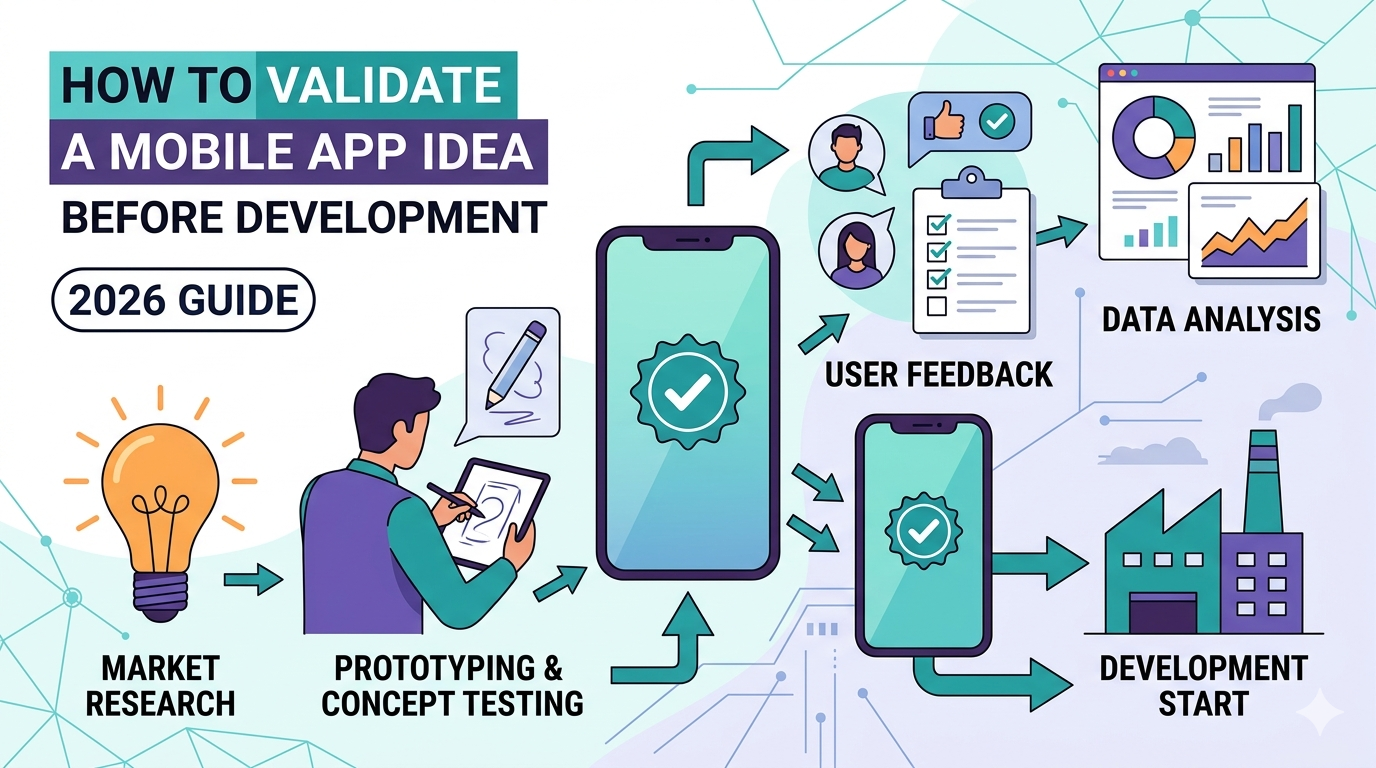
How to Validate a Mobile App Idea Before Development (2026 Guide)

How to Validate a Mobile App Idea Before Development (2026 Guide)

Most startups don’t fail because of bad development — they fail because they build something nobody actually needs.

Validating your mobile app idea before development is the single most important step in the entire startup journey. It saves you time, money, and months of wasted effort.

In this guide, you’ll learn a practical, no-fluff approach to validate your app idea before investing in development.


1. Start With the Problem, Not the App

A strong app idea always starts with a real problem.

Ask yourself:

  • What pain point am I solving?
  • How are people solving it today?
  • Why is the current solution not good enough?

If you can’t clearly define the problem, your app idea is not ready.

👉 Many founders skip this and jump straight to features — which leads to failure.
Read: Common Mistakes Startups Make When Building Their First App


2. Define Your Target Audience Clearly

“Everyone” is not a target audience.

Be specific:

  • Age group
  • Location (US, global, niche market)
  • Profession or lifestyle
  • Behavior patterns

Example:
Instead of “fitness app”, define:
→ “Busy professionals in the US who want 20-minute home workouts”

The more specific your audience, the easier validation becomes.


3. Analyze Competitors (Market Validation Shortcut)

If competitors exist, that’s a good sign — it means there’s demand.

Look at:

  • App Store & Play Store reviews
  • Feature gaps
  • Pricing models
  • User complaints

Your goal:
👉 Find what users hate — and build something better.

Also read: What Makes a Successful Mobile App Lessons From Real Products


4. Create a Simple Landing Page

Before building the app, build interest.
A landing page should include:

  • Problem statement
  • Your solution
  • Key benefits
  • Call-to-action (Join waitlist / Early access)

Tools:

  • Webflow
  • Framer
  • WordPress

Validation metric:

  • Conversion rate (5–15% is a strong signal)

If nobody signs up, your idea likely needs refinement.


5. Run Small Paid Ads (Fastest Validation Method)

This is one of the most underrated strategies.
Run ads on:

  • Facebook / Instagram
  • Google Ads

Target your ideal audience and measure:

  • Click-through rate (CTR)
  • Cost per signup
  • Engagement

👉 If people are willing to click and sign up, your idea has potential.


6. Talk to Real Users (This Changes Everything)

This is where real validation happens.

Talk to at least 10–20 potential users and ask:

  • How do you currently solve this problem?
  • What frustrates you the most?
  • Would you pay for a better solution?

You’ll often realize:
👉 Your original idea needs adjustments — and that’s a good thing.


7. Build a No-Code or Prototype Version

Before full-scale development, create a prototype or no-code MVP.

Options:

  • Figma prototype
  • Glide / Bubble (no-code apps)

Goal:

  • Test user flow
  • Validate usability
  • Get early feedback

👉 This step prevents expensive mistakes during development.


8. Define Your MVP (Only What Matters)

Once validated, define your MVP.

Focus on:

  • Core feature only
  • Essential user journey
  • Fast launch

Avoid:

  • Extra features
  • Complex backend
  • Over-engineering

👉 Learn how to define MVP correctly:
MVP App Development Features Yoou Actually Need And What To Skip
StartUp MVP Development Guide From Idea To Launch


9. Estimate Cost Before You Build

Validation also means understanding if your idea is financially viable.

Questions to ask:

  • How much will development cost?
  • Can I recover this cost?
  • What’s the revenue model?

👉 Cost breakdown: Mobile App Development Cost 2026 – Complete Pricing Breakdown
Also consider ways to reduce cost: How To Reduce Mobile App Development Cost Without Sacrificing Quality


10. Choose the Right Platform for Testing

You don’t need to build everything at once.

  • Start with iOS for US audience validation
  • Use cross-platform if budget is tight
  • Expand later based on traction

👉 Platform decision guide:
iOS Vs Android Development Which Is Better For Your App In 2026
Native Vs Cross-Platform App Development – Pros/Cons and Costs


11. Validate Willingness to Pay (Critical Step)

Many ideas get users — but no revenue.

Test:

  • Paid early access
  • Subscription interest
  • Pre-orders

👉 If users won’t pay, you don’t have a business yet — just an idea.


12. Prepare for Development Only After Validation

Once your idea is validated:

  • Finalize features
  • Choose tech stack
  • Hire developers
  • Start development

👉 Development process: Mobile App Development Process – Step By Step Guide
👉 Hiring guide: How To Hire The Right Mobile App Development Company – 2026 Guide
👉 Tech stack: Best Tech-Stack For Mobile App Development In 2026


Final Thoughts

Validating your mobile app idea is not optional — it’s mandatory.

Without validation:

  • You’re guessing

With validation:

  • You’re building with confidence

The smartest founders don’t start with development.
They start with proof.


How to Hire the Right Mobile App Development Company (2026 Guide)

How to Hire the Right Mobile App Development Company

Hiring a mobile app development company is one of the most critical decisions you’ll make for your startup or business. The right partner can accelerate your product, reduce costs, and help you scale. The wrong one can burn your budget, delay your launch, and leave you with a product that doesn’t work.

This guide breaks down exactly how to choose the right mobile app development company — without wasting time or money.


1. Start With Clarity: What Are You Building?

Before you even start searching for a mobile app development company, you need clarity on your product.

Define:

  • Your app idea
  • Target audience
  • Core features (MVP scope)
  • Budget range
  • Timeline expectations

If you’re still figuring this out, start here: How to turn your startup idea into a mobile app – 2026 Guide

👉 Companies can guide you, but they shouldn’t discover your idea for you.


2. Decide What Type of Company You Need

Not all app development companies are the same. Choosing the wrong type can cost you months.

Common options:

1. Freelancers

  • Lower cost
  • Good for very small projects
  • Risk: reliability, scalability

2. In-house team

  • Full control
  • Expensive and slow to build

3. Development agency (Recommended)

  • Structured process
  • Full team (design, development, QA)
  • Faster delivery

👉 For most startups and businesses, a mobile app development agency or remote development company is the best choice.

Read more: Hire Remote Developers – Practical Guide For Startups businesses


3. Evaluate Their Portfolio (Not Just UI)

A good-looking app doesn’t mean good engineering.

When reviewing a company:

  • Check live apps on App Store / Play Store
  • Look at performance (speed, crashes, UX)
  • Evaluate complexity (APIs, real-time features, scaling)

Ask:

  • Have they built apps similar to yours?
  • Do they have experience in your industry?

👉 Strong portfolios show problem-solving ability, not just design.


4. Understand Their Development Process

A reliable mobile app development company will always follow a structured process.

Typical flow:

  1. Discovery & requirement gathering
  2. Wireframing & UI/UX
  3. Development
  4. Testing & QA
  5. Deployment

👉 If a company jumps straight to coding, that’s a red flag.

Detailed process: Mobile App Development Process – Step By Step Guide


5. Check Their Technical Expertise

The right company should guide you on:

  • iOS vs Android strategy
  • Native vs cross-platform development
  • Tech stack decisions

👉 If they just say “we do everything,” dig deeper.

Helpful reads:
iOS Vs Android Development – Which is better for your app in 2026
Native Vs Cross-Platform App Development – Pros/Cons and Costs
Best Tech-Stack for Mobile App Development in 2026


6. Ask About Cost — But Focus on Value

Cost matters, but choosing the cheapest option often leads to higher long-term costs.

Typical US market pricing (competitive range):

  • MVP: $15,000 – $30,000
  • Mid-level app: $30,000 – $80,000
  • Complex app: $80,000 – $150,000+

👉 The key is ROI, not just price.

Understand pricing in detail: Mobile App Development Cost 2026 – Complete Pricing Breakdown


7. Understand Timeline Expectations

Unrealistic timelines are a major red flag.

Typical timelines:

  • MVP: 6–12 weeks
  • Full app: 4–8 months

👉 If someone promises a full app in 2–3 weeks, expect quality issues.
Read more: How long it takes to build a mobile app – 2026 Guide


8. Evaluate Communication & Transparency

This is where most projects fail.

Check:

  • How quickly they respond
  • How clearly they explain things
  • Whether they ask the right questions

You want a partner who:

  • Challenges your assumptions
  • Suggests better solutions
  • Keeps you updated regularly

👉 Good communication = fewer delays + better product.


9. Ask About Post-Launch Support

Your app doesn’t end at launch.

You’ll need:

  • Bug fixes
  • Updates
  • Performance optimization
  • New features

👉 Make sure the company offers long-term support.
Learn more: App Maintenance costs – What happens after launch ?


10. Look for Startup Experience (This Matters More Than You Think)

Startups move fast. Requirements change. Priorities shift.

A company experienced with startups will:

  • Focus on MVP first
  • Avoid overengineering
  • Help you iterate quickly

👉 This can save you months of time and thousands of dollars.

Recommended read:
MVP App Development Features You Actually Need And What To Skip
StartUp MVP Development Guide – From Idea to Launch


11. Watch for Red Flags

Avoid companies that:

  • Promise unrealistically low pricing
  • Guarantee timelines without understanding scope
  • Skip discovery phase
  • Have no real portfolio
  • Don’t discuss scaling or maintenance

👉 These are signs of inexperienced or unreliable teams.

Also read: Common Mistakes Startups Make When Building Their First App


12. Think Long-Term: Can They Scale With You?

Your app will grow — your development partner should too.

Ask:

  • Can they handle scaling to 100K+ users?
  • Do they understand backend architecture?
  • Can they support future features?

👉 Scaling matters more than initial development.

Scaling guide: How to Scale a Mobile App After 10K/100K/1m Users


Final Thoughts

Hiring the right mobile app development company is not about finding the cheapest option — it’s about finding the right partner.

The best companies:

  • Understand your business
  • Guide your decisions
  • Build scalable products
  • Help you grow after launch

If you choose wisely, your development partner becomes a long-term asset — not just a vendor.

How to Turn Your Startup Idea Into a Mobile App (2026 Guide)

How to Turn Your Startup Idea Into a Mobile App

Turning a startup idea into a successful mobile app is not about coding first — it’s about clarity, validation, and execution. Most startups fail not because of poor development, but because they skip the fundamentals.

In this guide, we’ll break down a practical, step-by-step approach to transform your idea into a scalable mobile app, while keeping development costs, timelines, and risks under control.


1. Validate Your Startup Idea First (Don’t Skip This)

Before writing a single line of code, validate your idea.

Ask yourself:

  • What exact problem am I solving?
  • Who is my target user?
  • Why would someone switch to my app?

Validation methods:

  • Landing page with signup waitlist
  • Competitor research
  • Talking to real users
  • Running small paid ads

👉 If you skip this, you risk building something nobody wants — one of the most common startup mistakes.
Read more : Common mistakes startups make when building their first app


2. Define Your MVP (Minimum Viable Product)

An MVP is not a “basic version” — it’s the smallest version of your app that delivers real value.

Focus on:

  • 1 core feature
  • 1 user journey
  • 1 target audience

Avoid:

  • Feature overload
  • Fancy UI early on
  • Trying to compete with established apps

👉 The goal is speed + learning, not perfection.

Detailed guide:
1. MVP App Development Features You Actually Need and What To Skip
2. Startup MVP Development Guide From Idea to Launch


3. Choose the Right Platform (iOS, Android, or Both?)

This decision directly impacts your cost and timeline.

Go with iOS first if:

  • Your audience is premium
  • You want faster development
  • You’re testing early-stage idea

Go with Android first if:

  • You’re targeting mass users (India, SEA)
  • Budget is limited

Go cross-platform if:

  • You need both platforms quickly
  • You want to reduce development cost

👉 Read full comparison:
1. iOS Vs Android Development Which is better for your app in 2026
2. Native Vs Cross-Platform App Development – Pros/Cons and Costs


4. Decide the Right Tech Stack

Your tech stack determines:

  • Performance
  • Scalability
  • Maintenance cost

Typical modern stack (2026):

  • Frontend: SwiftUI / Kotlin / Flutter
  • Backend: Node.js / Firebase / Supabase
  • Database: PostgreSQL / Firestore

👉 Full breakdown:
Best Tech-Stack For Mobile App Development in 2026


5. Estimate Cost & Timeline

This is where most founders get surprised.

Typical US market pricing (competitive, below average):

  • Basic MVP app: $15,000 – $30,000
  • Mid-level app (API integrations, dashboards): $30,000 – $80,000
  • Complex app (real-time, AI, scaling systems): $80,000 – $150,000+

Timeline:

  • MVP: 6–12 weeks
  • Full product: 4–8 months

👉 Detailed breakdown:
1. Mobile App Development Cost In 2026 – Complete Pricing Breakdown
2. How long does it take to build a mobile app – 2026 Guide


6. Hire the Right Development Team

You have three main options:

  • Freelancers
  • In-house team
  • Remote development agency

For US startups, remote development teams offer the best balance:

  • Lower cost than US agencies
  • High-quality engineering
  • Faster turnaround

👉 Hiring guide: Hire Remote Developers Guide For Startup Businesses


7. Follow a Structured Development Process

A proper mobile app development process looks like this:

  1. Requirement gathering
  2. Wireframes & UI/UX design
  3. Development (frontend + backend)
  4. Testing & QA
  5. Deployment (App Store + Play Store)

👉 Full process explained: Mobile App Development Process – Step by Step Guide


8. Launch Fast, Then Iterate

Your first version is not your final product.

After launch:

  • Track user behavior
  • Collect feedback
  • Improve features

👉 Successful apps evolve continuously, not perfectly at launch.

Learn what makes apps successful: What makes a successful mobile app – lessons from real products


9. Plan for Post-Launch Costs

Many founders overlook this.

Ongoing costs (US market):

  • Maintenance: $1,000 – $5,000/month
  • Cloud hosting: $200 – $2,000+/month
  • Feature updates: variable

👉 Learn more: App Maintenance costs – What happens after launch?


10. Scale Your App as You Grow

Scaling is not just technical — it’s strategic.

At different stages:

  • 10K users: Optimize performance
  • 100K users: Improve backend architecture
  • 1M users: Invest in infrastructure & analytics

👉 Scaling guide: How to Scale a Mobile App After 10K/100K/1m Users


11. Optimize Costs Without Sacrificing Quality

Smart startups don’t overspend — they optimize.

Cost-saving strategies:

  • Start with MVP
  • Use cross-platform when appropriate
  • Hire remote teams instead of full US in-house
  • Focus only on revenue-driving features

👉 Read more: How to reduce mobile app development cost without sacrificing quality


Final Thoughts

Turning your startup idea into a mobile app is not a one-step process — it’s a journey:

Idea → Validation → MVP → Launch → Scale

The difference between failed and successful startups isn’t just the idea — it’s execution speed, cost efficiency, and continuous improvement.

If you approach it correctly, your app doesn’t just get built — it becomes a scalable business.


What Makes a Successful Mobile App? Lessons From Real Products

What Makes a Successful Mobile App? Lessons From Real Products

Every year, thousands of mobile apps are launched — but only a small percentage actually succeed.

Some apps gain millions of users, scale globally, and generate revenue. Others struggle with low engagement, poor retention, and eventually fade away.

So what separates a successful mobile app from one that fails?

After working with startups and businesses on mobile app development, MVPs, and scaling products, we’ve seen clear patterns. In this article, we break down what actually makes a mobile app successful, based on real-world product experience — not theory.

1. Successful Apps Solve One Clear Problem

The most successful mobile apps are simple at their core.
They don’t try to do everything. They focus on one strong value proposition.

Examples:

  • Uber → Book a ride instantly
  • WhatsApp → Simple, fast messaging
  • Airbnb → Find and book stays

If your app cannot clearly answer:
👉 “Why would someone use this app?”
…it will struggle to gain traction.

This is exactly why most startups begin with an MVP. If you’re still shaping your idea, start with our
👉 Startup MVP Development Guide

2. Great User Experience (UX) Wins Every Time

A successful mobile app is not just functional — it is easy and intuitive to use.

Users expect:

  • Fast loading screens
  • Smooth navigation
  • Clear actions
  • Minimal friction

If users have to “figure out” your app, they will leave.

In fact, many apps fail not because of bad ideas, but because of poor UX design and usability issues.

👉 If you’re building your first app, avoid these pitfalls:
Common Mistakes Startups Make When Building Their First App

3. Performance and Stability Are Non-Negotiable

No matter how good your idea is, if your app:

  • crashes
  • lags
  • drains battery
  • or freezes

users will uninstall it.

Modern users expect apps to be:

  • fast
  • stable
  • responsive

This is where choosing the right mobile app tech stack and architecture becomes critical.
👉 Learn more about this here:
Best Tech Stack for Mobile App Development in 2026

4. Strong MVP First, Then Smart Scaling

Successful apps don’t launch with 50 features.
They start with:

  • a focused MVP
  • real user feedback
  • rapid iterations

Many failed apps made the mistake of overbuilding too early.
👉 If you’re planning features, read: MVP App Development: Features You Actually Need

Once the app gains traction, scaling becomes the next challenge.
👉 Scaling strategy matters a lot: How to Scale a Mobile App

5. Choosing the Right Platform Strategy

One common question founders ask:
👉 Should we build for iOS, Android, or both?

The answer depends on:

  • target audience
  • budget
  • timeline
  • monetization strategy

Choosing the wrong platform can delay growth.
👉 If you’re deciding this, read: iOS vs Android Development Guide

Also consider whether native or cross-platform makes more sense:
👉 Native vs Cross-Platform Development

6. Continuous Improvement After Launch

A successful mobile app is never “done.”

After launch, you must:

  • fix bugs
  • release updates
  • improve features
  • optimize performance

Many founders underestimate this phase.
👉 Understand what happens after launch: App Maintenance Costs Guide

Apps that don’t evolve quickly lose users to competitors.

7. Clean Architecture & Long-Term Thinking

Apps that succeed long-term are built with:

  • clean architecture
  • scalable backend
  • modular code
  • maintainable systems

If you skip this early, you may eventually need a rewrite.
👉 This is more common than you think: When Should You Rewrite Your Mobile App?

8. Realistic Budget & Planning

Many startups fail because they underestimate cost and timelines.

A successful mobile app is not just about building — it’s about planning properly.
👉 If you’re budgeting your app: Mobile App Development Cost Guide
👉 And timeline expectations: How Long Does It Take to Build an App?

9. The Right Development Partner Matters

Even with a great idea, poor execution can kill a product.
Successful apps are built by teams that understand:

  • product thinking
  • scalability
  • user behavior
  • long-term architecture

Many businesses choose to work with experienced teams or hire remote developers.
👉 If you’re exploring that: Hire Remote Developers in India

Final Thoughts: Success Is Built, Not Luck

Successful mobile apps are not built by chance.

They are built through:

  • clear problem-solving
  • strong execution
  • continuous improvement
  • smart technical decisions

If you focus on:

  • user experience
  • performance
  • scalability
  • and real-world usage

you dramatically increase your chances of success.

Startup MVP Development Guide: From Idea to Launch

Startup_MVP_Development_Guide_From_Idea_to_Launch

Every successful startup begins with a simple question: Does anyone actually want this product?

Instead of spending months and large budgets building a full product, smart founders start with MVP development — a Minimum Viable Product that validates the idea quickly with real users.

In this startup MVP development guide, we’ll walk through the entire process:

  • How to turn an idea into an MVP
  • What features your MVP actually needs
  • How long MVP development takes
  • How much it costs to build an MVP
  • What happens after launch

If you’re a founder planning startup app development, this guide will help you move from idea to launch in the most efficient way.

What Is an MVP in Startup Development?

An MVP (Minimum Viable Product) is the simplest version of your product that solves a real user problem.
The goal of MVP development is not to build a perfect product — it’s to validate your idea quickly.

A good startup MVP should:

  • Solve one clear problem
  • Deliver real value to users
  • Be built quickly
  • Allow you to gather user feedback

This approach reduces risk and prevents startups from building products nobody wants.
If you’re still deciding what features to include, you may find our article helpful:

👉 MVP App Development: Features You Actually Need (and What to Skip)

Why Startups Should Build an MVP First

Many startup founders think they need a fully developed product before launching.
In reality, the opposite is true.

Building an MVP helps startups:

Validate product-market fit

You learn whether real users actually want your product.

Save development cost

Instead of spending $100K+ building everything, you start small.

Launch faster

Most MVPs can be built in 8–16 weeks depending on complexity.
If you’re wondering about development timelines, read:

👉 How Long Does It Take to Build a Mobile App?

Attract investors

Investors prefer startups with working products and early traction.

Step 1: Validate Your Startup Idea

Before writing code, you must validate your idea.

Ask yourself:

  • Who is the target user?
  • What problem are they facing?
  • How are they solving it today?
  • Why is your solution better?

Many startup founders skip this step and jump directly into development.
This is why many apps fail.

A better approach is to:

  • Talk to potential users
  • Run small surveys
  • Study competitors
  • Build simple prototypes

Once validation looks promising, you can move to MVP development.

Step 2: Define the Core MVP Features

One of the biggest mistakes startups make is building too many features in their MVP.
Your MVP should focus on the core user flow.

Examples of core MVP features:

  • User registration / login
  • Basic dashboard or interface
  • Core product functionality
  • Basic backend system
  • Simple admin panel

Avoid advanced features like:

  • AI recommendations
  • complex analytics
  • multi-language support
  • advanced notifications

We discuss this in detail here:
👉 MVP App Development: Features You Actually Need (and What to Skip)

Step 3: Choose the Right Tech Stack

Technology choices impact the speed, scalability, and cost of your MVP.
For most startups building mobile apps:

iOS Development

  • Swift
  • SwiftUI

Android Development

  • Kotlin
  • Jetpack Compose

Backend technologies

  • Node.js
  • Python
  • PHP
  • Go

Choosing the right stack early prevents expensive rewrites later.
You can learn more here:

👉 Best Tech Stack for Mobile App Development in 2025

Step 4: Design a Simple, Usable Interface

Your MVP does not need award-winning design.
But it must be easy to use.

Focus on:

  • Clear user flow
  • Simple navigation
  • Fast onboarding
  • Minimal screens

Good UX increases user retention and improves your chances of validating the product.

Step 5: Build the MVP App

Once features and architecture are defined, the development phase begins.
Typical MVP development stages include:

Product planning

Define requirements and development roadmap.

UI/UX design

Create wireframes and interface layouts.

Development

Frontend and backend implementation.

Testing

Fix bugs and ensure stability.

Deployment

Launch on App Store, Play Store, or web.
A typical startup MVP takes:

8 – 16 weeks

depending on features and complexity.

Step 6: Launch and Collect User Feedback

Launching your MVP is just the beginning.
Now you need to learn from users.

Track metrics such as:

  • Signups
  • Active users
  • Retention
  • Feature usage
  • Drop-off points

User feedback will help you prioritize future features.

Step 7: Improve and Scale the Product

Once your MVP shows traction, you can start improving the product.

This may include:

  • adding new features
  • improving UI
  • scaling infrastructure
  • optimizing performance

As your user base grows, scaling becomes important.

If you’re planning for growth, read:

👉 How to Scale a Mobile App After 10K, 100K, and 1M Users

How Much Does MVP Development Cost?

Startup MVP development costs vary based on:

  • feature complexity
  • platform (iOS, Android, or both)
  • backend requirements
  • integrations

For most startups:

MVP development cost typically ranges between $10,000 and $40,000.
If you’re budgeting your project, you can read:

👉 How Much Does It Cost to Build a Mobile App?

Common Mistakes Startups Make With MVPs

Many startups fail not because the idea is bad, but because the MVP was built incorrectly.
Common mistakes include:

Building too many features

Focus on core functionality only.

Ignoring user feedback

Real users will guide your roadmap.

Poor architecture

Bad architecture leads to scaling problems later.

Skipping product validation

Always validate before building.
We explain these mistakes in more detail here:

👉 Common Mistakes Startups Make When Building Their First App

When Should You Rebuild Your MVP?

Some MVPs are built quickly and may not scale long-term.
If your app:

  • crashes frequently
  • is hard to maintain
  • has performance issues
  • cannot support new features

It may be time for a rebuild.
You can learn more here:
👉 When Should You Rewrite Your Mobile App?

How Nerdware Labs Helps Startups Build MVPs

At Nerdware Labs, we work with founders and startups to turn ideas into real products.

Our startup MVP development approach focuses on:

  • clear product strategy
  • clean, scalable architecture
  • fast development cycles
  • transparent communication
  • long-term scalability

With 14+ years of mobile app development experience, we help startups launch production-grade MVPs that can grow into full platforms.

Learn more about our services:

👉 Startup MVP Development Services

Final Thoughts

Startup success is not about building the biggest product first.
It’s about building the right product quickly.
A well-planned MVP helps you:

  • validate your idea
  • attract early users
  • reduce development risk
  • launch faster
  • scale with confidence

If you’re planning to build a startup app, starting with a well-designed MVP is the smartest path.


Mobile App Development Process: Step-by-Step Guide

app_development_guide

Building a successful mobile app is not just about writing code. Behind every reliable product is a structured mobile app development process that turns an idea into a scalable, production-ready application.

For startups and businesses planning to build an app, understanding the mobile app development process step by step helps you:

  • Estimate realistic timelines
  • Avoid common development mistakes
  • Control development costs
  • Build a scalable product from the beginning

In this guide, we’ll walk through the complete mobile app development process, from validating an idea to launching and maintaining the application.

Step 1: Define the App Idea and Business Goal

Every successful app starts with a clearly defined problem.

Before starting the mobile app development process, you should answer a few key questions:

  • What problem does the app solve?
  • Who is the target user?
  • What value does the app provide?
  • How will the app generate revenue or growth?

Many startups skip this step and rush into development, which leads to wasted time and budget.

In fact, one of the biggest problems founders face is building the wrong product. We explain these mistakes in our article: Common Mistakes Startups make when building their first app.
Clarifying the product vision early makes the rest of the app development process much smoother.

Step 2: Define the MVP (Minimum Viable Product)

Once the idea is validated, the next stage in the mobile app development process is defining an MVP.

An MVP (Minimum Viable Product) includes only the essential features needed to deliver value to users. This approach allows startups to launch faster and gather feedback before investing heavily.

Typical MVP features include:

  • User registration and login
  • Core functionality of the app
  • Basic UI for usability
  • Backend infrastructure

Many startups overbuild their first version. To understand which features truly belong in an MVP, read our guide here

Step 3: Choose the Right Technology Stack

Choosing the right technology stack is a critical part of the mobile app development process.

The tech stack determines:

  • App performance
  • Development speed
  • Maintenance costs
  • Scalability

Modern mobile apps typically use technologies like:

For iOS development

  • Swift
  • SwiftUI

For Android development

  • Kotlin
  • Jetpack Compose

Backend technologies

  • Node.js
  • Python
  • PHP
  • Cloud infrastructure

If you’re comparing development platforms, our article explains the differences between iOS and Android development:
👉 https://www.nerdwarelabs.com/blogs/ios-vs-android-development-which-is-better

You can also explore the latest frameworks and tools in our guide:
👉 https://www.nerdwarelabs.com/blogs/best-tech-stack-for-mobile-app-development-in-2025

Choosing the right stack early prevents technical debt later.

Step 4: UI/UX Design

After defining the architecture, the next stage of the mobile app development process is designing the user experience.

Good mobile app design focuses on usability rather than decoration.

Key goals of mobile app UI/UX include:

  • Simple navigation
  • Clear user flows
  • Fast onboarding
  • Consistent visual hierarchy

A well-designed product helps users understand the value of the app quickly and improves retention.

Step 5: Mobile App Development

This is the phase where the app is actually built.

The development stage includes:

Frontend Development

Building the mobile interface and user interactions.

Backend Development

Developing APIs, databases, and server infrastructure.

Integrations

Connecting the app with payment systems, analytics tools, and third-party services.

Many founders underestimate how long development takes. To get a realistic timeline, read:
👉 https://www.nerdwarelabs.com/blog/how-long-does-it-take-to-build-a-mobile-app-2026-guide/

Following a structured mobile app development process ensures development stays on schedule.

Step 6: Testing and Quality Assurance

Before launch, the app must go through rigorous testing.

Testing ensures the application works reliably across different devices and operating systems.

Quality assurance typically includes:

  • Functional testing
  • Performance testing
  • Security testing
  • Device compatibility testing

Skipping testing often leads to negative user reviews and app store rejection.

Step 7: App Store Launch

After testing, the app is ready to be published on the Apple App Store and Google Play Store.

The launch stage includes:

  • Preparing store listings
  • App screenshots and descriptions
  • Uploading builds
  • App store approval

Although launching an app is a major milestone, it is not the end of the mobile app development process.

Step 8: App Maintenance and Updates

Once the app is live, ongoing maintenance becomes essential.

Post-launch maintenance typically includes:

  • Bug fixes
  • Performance improvements
  • OS compatibility updates
  • Security patches

Many businesses underestimate maintenance costs. We cover this in detail here:
👉 https://www.nerdwarelabs.com/blog/app-maintenance-costs-what-happens-after-launch/

Maintaining an app regularly ensures long-term stability and user satisfaction.

Step 9: Scaling the App

As your user base grows, your infrastructure and architecture must scale.

Scaling often involves:

  • Optimizing backend systems
  • Improving database performance
  • Adding new features
  • Improving monitoring and analytics

Our article explains how apps evolve as they grow:
👉 https://www.nerdwarelabs.com/blog/how-to-scale-a-mobile-app-after-10k-100k-and-1m-users/

Planning scalability early in the mobile app development process prevents major problems later.

When Apps Need to Be Rewritten

Over time, some apps accumulate technical debt and become difficult to maintain.

In such cases, businesses may decide to rewrite the mobile app using modern architecture.

Signs a rewrite may be needed:

  • Frequent crashes
  • Slow performance
  • Outdated frameworks
  • Difficulty adding new features

If you’re facing these issues, read:
👉 https://www.nerdwarelabs.com/blog/when-should-you-rewrite-your-mobile-app/

How Nerdware Labs Helps Build Mobile Apps

At Nerdware Labs, we follow a proven mobile app development process designed to help startups and businesses build scalable digital products.

Our team specializes in:

  • iOS and Android mobile app development
  • Startup MVP development
  • Backend and cloud architecture
  • UI/UX design
  • App scaling and maintenance

Learn more about our services:
👉 https://www.nerdwarelabs.com/services/mobile-app-development.php

With 14+ years of engineering experience, we focus on building production-grade apps that work reliably in real-world conditions.

Final Thoughts

Understanding the mobile app development process helps founders plan realistic timelines, manage budgets, and build scalable products.

The typical process includes:

  1. Idea validation
  2. MVP definition
  3. Technology stack selection
  4. UI/UX design
  5. Development
  6. Testing
  7. Launch
  8. Maintenance and scaling

Following a structured development process significantly increases the chances of building a successful mobile app.